Myths Regarding Dental Health and Hygiene Among the Employees of a Tertiary Care Hospital: Single Centre Study
Mansoor Habib Fida Shah1, Muhammad Mohsin Javaid2, Umme Kulsoom Khattak3, Farhan Javed2, Basil Khalid Waheed4, Anosha Mujtaba2
1Department of Dentistry, Khan Research Laboratories Hospital, Islamabad; 2School of Dentistry, Shaheed Zulfiqar Ali Bhutto Medical University Islamabad; 3Shifa College of Medicine, Shifa Tameer-e- Millat University, Islamabad; 4Department of Dentistry, Multan Medical and Dental College, Multan
Objective: To identify various myths and misconceptions regarding dental health and hygiene among the non-medical employees of a tertiary care hospital.
Methodology: This cross-sectional descriptive study was conducted among 200 non-medical regular employees of a public tertiary care hospital of Islamabad. Simple random sampling was used to collect data using self-constructed mixed questionnaire. Doctors, nurses and paramedics were excluded from the study. Ethical approval from Institute of Review board was taken before commencing the study.
Results: Study population comprised of 200 respondents with majority (n=190) males, above the age of 40 years (n=118). Majority were married (n=185) and had education of Maters level (n=124). Dental problem was experienced by 94.5% participants. Majority (58.5%) used tooth brush to clean their tooth compared to 5% using miswak and 2.5% danadasa. More than half (54%) of participants believed that gap between upper incisors is symbol of good fortune whereas 41.5% believed that eye sight can be affected following dental extraction. One-fourth (24.5%) participants believed that wisdom tooth has some link with the wisdom. Majority (63.5%) believed that the procedure of scaling weakens the teeth.
Conclusion: Non-medical employees believe in outdated false stories and myths regarding dental health and hygiene. We recommend educational and counselling sessions for our population specially the ones working in a healthcare facility regarding dental health. There is strong need to discourage various myths prevailing in the community by endorsing health promotion.
Keywords: Myths, brushing, extraction, pain, scaling
Oral and dental health is established by maintenance of adequate and appropriate dental and oral hygiene which refers to a set of practices that preserve the health of teeth, gums and other oral structures, as teeth have great impact on individual’s personality. These practices include self-employed habits such as regularly brushing teeth and even dental check-ups by a dentist.1,2 This word ‘myth’ comes from ancient Greek word meaning ‘plot or story of unknown origin or a speech’.3 Myths are beliefs, cultural and traditions identities without any scientific explanation or determinable basis. Some myths highlight the cultural differences and are riotously obscure.4 Myths are beliefs that are rooted in little to no evidence, possessing positive or negative connotations and shaped by society and culture often due to inadequacy in knowledge and propagation of hearsay. As with most healthcare related things, oral hygiene is not immune to the ever-prevalent myths and misconceptions surrounding it, creating a possible barrier against optimal oral hygiene practices and consequently oral health. This was most evident during the COVID-19 pandemic which brought with it a myriad of problematic myths of its own.5 While some may be harmless, others have the potential to misinform community at large and deviate them from a potential beneficial outcome; in this case, pursuing oral healthcare.6 Taboo originates after a Tongan word “tabu”, meaning forbidden or set apart. No taboo is recognized to be worldwide, but some are common in majority of civilizations.7 Belief patterns vary from place to place and culture to culture; the western world may harbour a unique subset of myths compared to the countries of the subcontinent which are prone to be influenced by extreme cultural and religious diversity. Both western and Chinese cultures have myths8. Moreover, having an association with self-esteem and physical appearance can make the individuals more likely to develop or fall prey to myths in an attempt to preserve their aesthetic health.9 All these myths are much prevalent in the developing nations. Pakistan is one of these countries with 43% population being illiterate and 64% persons residing in rural areas.10 Many unfounded theories, misconceptions and myths are always revolving in print and social media.11 Nevertheless, media coverage has done a substantial job to raise knowledge.12 There are many myths in dentistry.13 Some people think scaling breaks a tooth into the fragments.14 Some persons apprehend that scaling procedure can weaken the teeth, results in mobility and extracting any upper teeth may lead to loss of vision, dental procedures are always painful.15
Lack of education accompanied by socio-cultural factors and traditional beliefs lead to the development of mendacious myths and perceptions.16 Efforts have been made by the dental community to propagate evidence-based knowledge and eradicate myths at the grass root level. Yet, the literature still alerts to an ever-prevailing need to strengthen awareness strategies.17 To analyse this situation from a different perspective, the hospital non-medical personnel other than doctors, dentists and paramedics were surveyed for the presence of any myths and correlate whether being in the environment of a health-care facility by itself has any effects in harbouring or at least believing in potentially detrimental myths.
We conducted a cross-sectional descriptive study from March-April 2024 (2months), using self-constructed mixed questionnaire to collect data from non-medical employees of a public tertiary care hospital of Islamabad. Simple random sampling technique was used to select the participants. Using WHO sample size calculator, keeping confidence interval 95%, percent frequency 50, absolute precision 5, our sample size was calculated to be 200. First part of the questionnaire included demographic details while second part had information regarding dental health, hygiene and myths. The regular non-medical employees of the public tertiary care hospital were included in the study while doctors, dentists, nurses and paramedics were excluded from the study. Employees with less than one-year service or on contract were also excluded from the study. Informed written consent was taken from all the participants and they were assured that their identity will be kept anonymous. The data was stored and analysed using the Statistical Package for Social Sciences (SPSS), version 24. Frequency and percentages were calculated for qualitative variable. Ethical approval for the study was granted by the Shifa International Hospital Institutional Review Board and Ethics Committee (approval # 090-24).
Socio-Demographic Characteristics
Study population comprised of 200 respondents, with majority (n=190) males and above the age of 40 years (n=118). Majority were married (n=185) and education of Maters level (n=124). Socio-demographic details of participants are shown in table I.
Table I: Socio-Demographic characteristics |
|||
Variable with category |
Frequency |
Percentage |
|
Gender |
Male |
190 |
95 |
Female |
10 |
5 |
|
Age groups (years) |
21-25yrs |
1 |
0.5 |
26-30 |
17 |
8.5 |
|
31-35 |
22 |
11 |
|
36-40 |
42 |
21 |
|
>40 |
118 |
59 |
|
Marital status |
Married |
185 |
92.5 |
Unmarried |
15 |
7.5 |
|
Education Level |
Matriculation |
02 |
1 |
Inter |
42 |
21 |
|
Graduation |
20 |
10 |
|
Masters |
124 |
62 |
|
M-Phil & above |
12 |
6 |
|
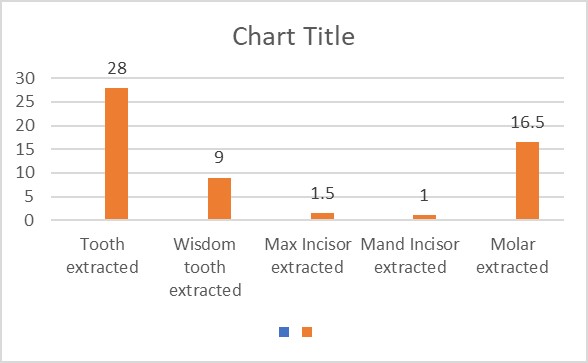
Figure 1: Tooth Extraction Details
Hygiene Practices and Frequency
Results showed that 94.5% of the respondents had experienced dental problems. Regarding consultation, majority (85%) participants reported that they consulted dentist.
The details of hygiene practices and its frequency are shown in tabulated form in table 2 When asked about history of tooth extraction, out of 200 respondents, 56 (28%) had a history of tooth extraction while 144 (72.0%) had never experienced it. The details shown in figure 1.
Myths regarding Dental Health
Various myths regarding dental health and treatment were explored in the results. These are summarized in table 3.
Table III: Myths regarding dental health |
|||
Myths about dental treatment |
Frequency |
Percentage |
|
Yes |
108 |
54.0 |
|
No |
92 |
46.0 |
|
Eye sight is affected after dental extraction |
Yes |
83 |
41.5 |
No |
117 |
58.5 |
|
Yes |
49 |
24.5 |
|
No |
151 |
75.5 |
|
Tooth extraction is the only solution for toothache |
Yes |
28 |
14.0 |
No |
172 |
86.0 |
|
Dental treatment is always painful |
Yes |
66 |
33 |
No |
134 |
67 |
|
Hard brush cleans the teeth better than soft brush |
Yes |
112 |
56 |
No |
88 |
44 |
|
Brushing for more than once a day damages the enamel of teeth |
Yes |
44 |
22 |
No |
156 |
78 |
|
Milk teeth do not need any kind of dental treatment |
Yes |
43 |
21.5 |
No |
157 |
78.5 |
|
Yes |
127 |
63.5 |
|
No |
73 |
36.5 |
|
There is no need of consulting the dentist if there is no dental problem apparently |
Yes |
38 |
19 |
No |
162 |
81 |
|
Oral health knowledge is a vital prerequisite for health promotion practices. Result of this study shows lack of knowledge about the dental health on part of the employees of this hospital. Prevalence of a large number of myths and misconceptions have been noticed. In this study, more than half participants (58.5%) used toothbrush alone, which is comparable to 79.4% of another research.18 It is understood in modern era that keeping one's teeth and mouth in good condition is essential to one's entire physical health.19 Overall the teeth and gums need proper care and cleaning throughout the day especially after the meals, but unfortunately individuals brush less frequently than is recommended, which overall compromised their oral hygiene.20 Many persons adopt tooth-brushing as their prime method of oral hygiene.21 In our study results 41.5% of total respondents believed in myth that eyesight is affected after dental extraction while 58.5% didn’t believed so. This could be compared with another local study, where 40% of total respondents believed in the same myth, which shows close similarity to our study results. Similarly comparing some other results, we found many other similarities like in our study 24.5% respondents believed that wisdom tooth has some link with the wisdom of humans compared to another study where 25.5% of the respondents believed that wisdom is related to human intelligence. While comparing the myth that gap between the upper incisors is symbol of good fortune; my results show 54% of total respondents believed in this myth versus the same question in another study where 43% of respondents believed that the space between the maxillary central incisors is an indication of good luck.22 My results on this myth can also be compared to another study performed on strata of low socio-economic community in Karachi by khan SA where 47% of the respondents believed in the myth of tooth extraction affecting eye vision 15. In this study, most of participants were master degree holder, which is much better than other survey where half of participants were under matric.23 Dental health has been neglected.24 In this study, despite of good educational status of all the participants, myths are prevailing among them regarding dental health treatment. Certain healthcare providers regularly provide their staff with educational seminars regarding dental health care. The primary goal of these initiatives is to raise healthcare professionals awareness & knowledge.25 Tele dentistry can also be used for this purpose.26 That shows not only education can give awareness but a targeted and specific guidance in future needed to aware the community against the prevailing myths and misconceptions that endangered their dental health by not visiting the dentist in time with fear of painful treatment or myths, fear of cross infection like getting Hepatitis B, C & COVID-19 by the use of contaminated instruments.27-29 Our study result of myth that dental extraction is the only solution for toothache shows 14% of total respondents believed in this myth which is half than that of another study from Karnataka. In this survey, 43 (21.5%) believed milk teeth do not need any kind of dental treatment because permanent teeth will erupt any way. This is not similar to another study, where 65% subjects believed that is no need of worry regarding milk teeth.30 In our study, 63.5% of total respondents believed in the myth that procedure of scaling weakens the teeth compared to the results of Hashim et al where 44% of the respondents perceived it truthful. More than half of subjects of this survey reported that hard brush cleans the teeth better than soft brush, which is dissimilar to another investigation (16.4%).10 Similarly, in our study, when explored regarding dental hygiene practices, results showed that 58.5% of respondents use tooth brush, 5% Miswak, 2.5% Dandasa, 28% tooth brush plus miswak or dandasa and 6% toothbrush plus any other like dental floss. This can be best compared to the study done by Tubaishat RS, where 72% of the Jordanian respondents used tooth brush ,20.5% use the tooth brush plus miswak and only 3% use miswak alone. In this survey, only 19% subjects believed that there is no need of consulting the dentist if there is no dental problem apparently, which is far less than that of another survey.31 Here the close similarity is found on the use of miswak between the study populations of two different societies. Main purpose of dental treatment is to get relief from pain and maintain oral functions.32,33 Dentistry has progressed a lot since long by the invention of local anaesthesia to make every dental treatment painless.34 Sometimes, dentinal hypersensitivity might be the cause of discomfort and patient needs scaling.35 Scaling is a very useful procedure to clean the teeth and gums of debris and calculus deposited at the junction of gums and teeth. If this is not done if required, then periodontitis may result which is a disease of periodontal tissues that may lead to mobility of teeth along with gum recession and bleeding.36 In this survey, 63.5% subjects said that procedure of scaling weakens the teeth which is very much different from another survey.37
Non-medical employees believe in outdated false stories and myths regarding dental health and hygiene. We recommend educational and counselling sessions for our population specially the ones working in a healthcare facility regarding dental health. There is strong need to discourage various myths prevailing in the community by endorsing health promotion.
- National Institute of dental and Craniofacial Research [cited 15 august 2023]. Available from: https://www.nidcr.nih.gov/health-info/oral-hygiene
- Sajid M, Noreen R, Jamil M, Javed M, Haider E, Ahmad M. Prevalance of dental traumatic injuries in young children in public school of Layyah. Pak Oral Dent J 2019; 39(4):337-340 https://podj.com.pk/index.php/podj/article/view/476
- Agatucci C. Culture, religion & myth: interdisciplinary approaches. Cocc. edu. 2010. https://web.cocc.edu/cagatucci/classes/hum211/CoursePack/culture.htm
- Salam T A A, Khinda VI, Alghamdi AM, Alharthi YZ, Hodan HM, Binsuwaidan MH et al. Evaluation of Some Dental Myths Among the Adult Population in Riyadh, Saudi Arabia: A Cross-Sectional Study. Cureus. 2023 Jan 13;15(1): e33759. https://doi.org/ 10.7759/cureus.33759.
- Malik JA, Musharraf S, Safdar R, Iqbal M. Myths and misconception of COVID-19 among hospital sanitary workers in Pakistan: Efficacy of a training program intervention. BMC Health Services Research. 2022 Dec;22(1):1-8. https://doi.org/10.1186/s12913-022-08217-6
- Collier R. Containing health myths in the age of viral misinformation. Cmaj. 2018 May 14;190(19): E578-. https://doi.org/10.1503/cmaj.180543
- Dagar J. Rhar A, Gautam N, Dheeraj M. Dental Myths and Taboos: Hurdles to Oral Health. Int Healthc Res J. 2019;3(5):176-178. https://doi.org/10.26440/IHRJ/0305.08276
- Shi W. The Difference Between Chinese Myth and Western Myth and its Reflections on Culture. Journal of Contemporary Educational Research. 2020 Nov 2;4(10).
- Shamim R, Nayak R, Satpathy A, Mohanty R, Pattnaik N. Self-esteem and oral health-related quality of life of women with periodontal disease–A cross-sectional study. J Indian Soc Periodontol. 2022 Jul;26(4):390. https://doi.org/10.4103/jisp.jisp_263_21
- Hashim Z, Gilani SI, Kabir S, Israr MY, Khan MA, Riasat M. Fake news, myths and remedies regarding oral health care in patients coming to a private teaching dental hospital of Peshawar, Pakistan. Journal Khyber College of Dentistry. 2020 Sep 30;10(03):57-62. https://doi.org/10.33279/jkcd.v10i03.211
- Chaudhary FA, Ahmad B, Khalid MD, Fazal A, Javaid MM, Butt DQ. Factors influencing COVID-19 vaccine hesitancy and acceptance among the Pakistani population. Hum Vaccin Immunother. 2021 Oct 3;17(10):3365-3370. https://doi.org/10.1080/21645515.2021
- Khan N, Sartaj R, Sajid M, Jamil M, Javaid M. Patient perception regarding cross infection control; a cross sectional study. Pak Oral Dent J 2021; 41(1):15-17
- Langrial RZ, Batool SM, Khan N, Mahmood A, Ali S, Rasheed D Et al. Apprehensions/Fear Due to Myths Associated with Scaling among patients attending Tertiary Care Hospital. Pakistan J Med Health Sci. 2023 Mar 24;17(03):30-32. https://doi.org/10.53350/pjmhs202317330
- Vignesh R, Priyadarshni I. Assessment of the prevalence of myths regarding oral health among general population in Maduravoyal, Chennai. Journal of education and ethics in dentistry. 2012 Jul 1;2(2):85. https://doi.org/10.4103/0974-7761.121262
- Khan SA, Dawani N, Bilal S. Perceptions and myths regarding oral health care amongst strata of low socio-economic community in Karachi, Pakistan. J Pak Med Assoc. 2012 Nov 1;62(11):1198-203.
- Griffin RW, Moorhead G. Organizational behavior: Managing people and organizations: South-Western Pub; 2011
- Gupta DV, Tripathi S, Kankane DN, Mishra DG, Kumar DS, Malhotra DS. Myths related to dentistry in people of Lucknow: a cross-sectional study. Saudi J Oral Dent Res. 2021;6(3):123-8. https://doi.org/10.36348/sjodr.2021. v06i03.004
- Al-Qahtani SM, Razak PA, Khan SD. Knowledge and practice of preventive measures for oral health care among male intermediate schoolchildren in Abha, Saudi Arabia. Int J Environ Res Public Health. 2020 Feb;17(3):703.
- Habib MF, Mahmood H, Khan J, Mahmood Y, Javaid MM, Imtiaz N et al. Effectiveness of proper brushing technique based on repetition and reinforcement on the oral health status of school children a quasi-experimental interventional design. JPTCP. 2023 Oct 16;30(18):602-9. https://doi.org/10.53555/jptcp.v30i18.3044
- Iba B, Adamu VE. Tooth brushing: An effective oral hygiene measure. Orapuh Journal. 2021 Jul 31;2(2):e811-.
- Raison H, Corcoran R, Harris RV. Is toothbrushing behaviour habitual? Cues, context, motivators and patient narratives. Community dentistry and oral epidemiology. 2021 Oct;49(5):478-86. https://doi.org/10.1111/cdoe.12624
- Nasir Z, Ahmed W, Iqbal F, Iqbal S, Tariq M, Saba A. Prevalence of social myths and taboos related to dental health among general population of Rawalpindi Pakistan. Pakistan Oral & Dental Journal. 2014 Sep 30;34(3). 520-3
- Siddiqi KM, Baig MZ, Shahid AM, Qureshi NA, Khan AM, Sohail F. Myths and Misconceptions Associated with Dental Extractions: A Cross Sectional Study. Pakistan J Med Research. 2021 Oct 25;60(3):137-42.
- Qamar, W. (2024). Dental health in the shadows of global commitments: Addressing neglected priorities in lower middle-income countries. Journal of the Pakistan Medical Association, 74(2), 413–414.
- Ashour AA. Knowledge, attitudes and practices regarding oral health and oral care among nursing staff at a mental health hospital in Taif, Saudi Arabia: a questionnaire-based study. Journal of Advanced Oral Research. 2020 May;11(1):34-44.
- Chaudhary FA, Ahmad B, Javed MQ, Mustafa S, Fazal A, Javaid MM et al. Teledentistry awareness, its usefulness, and challenges among dental professionals in Pakistan and Saudi Arabia. Digital Health. 2022 Mar; 8: 20552076221089776.
- Ahmad MU, Javaid SA, Saad-Ullah M, Mahmood AS, Javaid M, Mahmood R. Status of vaccination against hepatitis B virus among medical students of a private medical institute in Multan. Pak J Med Health Sci. 2021;15(4):703-5.
- Mansoor A, Mansoor E, Sana A, Javaid MM, Hussain K. Vaccination Status of Hepatitis-B Among Dental Patients Visiting a Public Health Sector of Islamabad. Ann Pak Inst Med Sci. 2023; 19(3):356-360.
- Javaid M, Chaudhary Fa, Fazal A, Khan Ea, Hyder M, Din Su. Mode of transmission of COVID-19, Oral Manifestations, Precautionary Measures/Clinical Strategies and Treatment Considerations in dentistry. Pakistan Journal of Medical and Health Sciences. 2022; 16(1):3-6.
- Bidyalaxmi M, Jain J. Assessment of dental myths among subjects aged 15 and above attending a dental institution in Karnataka. J Multidiscip Dent. 2018;4(1):5-11.
- Tubaishat RS, Darby ML, Bauman DB, Box CE. Use of miswak versus toothbrushes: oral health beliefs and behaviours among a sample of Jordanian adults. International Journal of Dental Hygiene. 2005 Aug;3(3):126-36. https://doi.org/10.1111/j.16015037.2005.00136.x
- Noor N, Mujtaba H, Humayoun S, Umer MF, Javaid MM, Rehman A. Comparison of endodontic pain observed with sodium hypochloride, hydrogen peroxide and normal saline based root canal irrigants. Ann Pak Inst Med Sci 2022;18(1):3–8
- Noor N, Azhar R, Sartaj R, Mujtaba H, Humayoun S, Javaid MM. Severity of post obturation pain in single versus multiple sittings endodontic treatment using rotary nickle titanium instruments. Ann Pak Inst Med Sci 2023;19(3):220–4
- Ahmad M, Noor A, Noreen R, Sajid M, Jamil M, Javaid M. Comparison of 0.5 mg dexamethasone and placebo used as premedication for success of inferior alveolar nerve block. Pakistan Oral & Dental Journal. 2021 Sep 29;41(3):148-51.
- Mansoor A, Mansoor E, Sana A, Javaid MM, Asghar MS, Hussain K. Active role of potassium nitrate toothpaste for treating dentine hypersensitivity and maintaining their normal physiology. Pak J Physiol. 2023 Sep 30;19(3):39-42.
- Lamont T, Worthington HV, Clarkson JE, Beirne PV. Routine scale and polish for periodontal health in adults. Cochrane Database Syst Rev. 2018 Dec 27;12(12):CD004625. https://doi.org/10.1002/14651858.CD004625
- Satcher D, Nottingham JH. Revisiting Oral Health in America: A Report of the Surgeon General. Am J Public Health. 2017;107(S1): S32–S33.

An Official Publication of
Islamabad Medical & Dental College
Volume 13 Issue 2
Address of Correspondence
Muhammad Mohsin Javaid
Email:
mohsinjavaid734@gmail.com
Authors’ Contribution: 1,2Conception; Literature research; manuscript design and drafting; 3,4 Critical analysis and manuscript review; 5,6Data analysis; Manuscript Editing.
Cite this article. Shah MHF, Javaid MM, Khattak UK, Javed F, Waheed BK, Mujtaba A. Myths Regarding Dental Health and Hygiene Among the Employees of a Tertiary Care Hospital: Single Centred Study. J Islamabad Med Dental Coll. 2024; 13(2): 319-325.
DOI: https://doi.org/10.35787/jimdc.v13i2.1209