Frequency of Incidental Carcinoma in Thyroids Operated for Multinodular Goiter
Mudassira Zahid1, Anum Usman2, Kiran Tauseef3,Humaira Zaffar 3, Awais Niaz 4, Noor Khan 5
1 Associate Professor, Department of Pathology, Mohiuddin Islamic Medical College, Mirpur, Azad Kashmir Pakistan
2 Assistant Professor, Department of Pathology, Al Nafees Medical College & Hospital, Islamabad Pakistan
3Associate Professor, Department of Pathology, Al Nafees Medical College & Hospital, Islamabad Pakistan
4Lecturer, Department of Pathology, Al Nafees Medical College & Hospital, Islamabad Pakistan
5Professor, Department of Pathology, Al Nafees Medical College & Hospital, Islamabad Pakistan
Background:
Multinodular goiter (MNG) is a common disease in Pakistan. However, malignancy can be found occasionally on histopathological examination of resected goiter specimens. The objective of this study was to determine the frequency of malignant lesions on histopathological examination in thyroid specimens operated for multinodular goiter.
Material and Methods: A total of 154 patients undergoing thyroid surgery with preoperative diagnosis of multinodular goiter (MNG) at Al Nafees Medical College and Hospital Islamabad, Pakistan were included in this study. The preoperative diagnosis of MNG was made upon physical examination of thyroid and ultrasound (n=62 cases). FNAC was done in selected cases (n=43). After gross examination, sections were taken from areas of thyroid with varied appearances including hemorrhagic, solid, firm, white, gray, gelatinous as well as necrotic areas. Qualitative variables were calculated in terms of percentages and mean and standard deviation were used for quantitative variables.
Results: Of the 154 patients with preoperative diagnosis of MNG, there were 139 (90%) female and only 15 (10%) male patients. The age range was 14-60 years with a mean age of 36 ± 10 years The incidence of thyroid carcinoma in patients operated for clinical diagnosis of MNG was 8% (n=12). Papillary thyroid carcinoma (PTC) was the most frequent type of malignancy (83.3%; n=10). Multifocality (60%; n=6), bilaterality (33.3%; n=4) and left lobe involvement (80%; n=8) of thyroid were more common with papillary thyroid carcinoma. Microcarcinoma (measuring 1cm or less) was found in 50% (n=5) of these PTC. Histological type of papillary carcinomas greater than 1 cm were follicular variant (n=3; 30%) and conventional (n=2; 20%) types. The maximum measurement of the tumor was 2 cm. In all cases of PTC, rest of the thyroid showed MNG on histopathology.
Conclusions:Incidental finding of thyroid malignancy in clinically diagnosed cases of MNG is not unusual. Papillary carcinoma of thyroid is the most common incidental malignant finding in these cases. Multilocularity in thyroid is not an indicator of benign disease process.
Key words: Incidental finding, Multinodular goiter, Papillary microcarcinoma, Papillary thyroid carcinoma.
Thyroid is an important endocrine gland. It is affected by variable pathologies with different biological behaviors. Thyroid enlargement is commonly encountered in surgical practice. In thyroidectomy specimens the most common benign pathology is multinodular goiter (MNG) and the most common malignant lesion is papillary carcinoma.1,2 Papillary carcinomas is characterized by its signature nuclear features including nuclear groves, inclusions and chromatin clearing along with papillary architecture 2.
The incidence of thyroid carcinoma is increasing worldwide3. In the United States, the incidence of thyroid carcinoma is reported to be 1% among all new cancer diagnosis4. Geographically, Pakistan is considered an endemic area for iodine deficiency and thyroid enlargement is frequent. In Pakistan, thyroid carcinomas have an incidence of 1.2% cases among all malignant tumors5. The thyroid carcinomas mostly present in the third and fourth decades of life and are more common in females as compared to males 6.
Incidental thyroid carcinoma is diagnosed in patients operated for any benign thyroid pathology with no suspicion of neoplasm on preoperative physical examination, ultrasound or FNAC7 Various studies documenting the frequent finding of malignancy in thyroids operated for benign conditions have been reported7, 8
Not all enlarged thyroids with multilocularity on clinical examination turn out to be benign. Increasing trends of thyroid surgery on mere clinical examination have been observed. This study is aimed at documenting the frequency of thyroid cancer in patients undergoing thyroidectomy for benign MNG in our settings. It will emphasize the need for a complete thorough preoperative investigative workup of patients with enlarged thyroid including targeted FNAC, thyroid scan and ultrasound examination in order to decrease the frequency of reoperations after initial partial thyroid surgery.
It was a descriptive cross-sectional study carried out in Al Nafees Medical College and Hospital, Islamabad Pakistan. The study duration was two and half years from January 2016 to June 2018. Consecutive sampling was done. All consecutive patients undergoing thyroid surgery (total, subtotal thyroidectomy or lobectomy) with preoperative diagnosis of multinodular goiter (MNG) were included in this study. Preoperative diagnosis of MNG was made on the basis of physical examination and ultrasound of the thyroid. FNAC was opted only for the patients having a suspicion of neoplastic pathology on physical examination. Patients having a solitary thyroid nodule and a preoperative suspicion of neoplasia on ultrasound or on FNAC were excluded from the study. Patients with previous thyroid surgery and enlarged neck lymph nodes were also excluded.
Thyroid specimens were routinely fixed in formalin. Gross examination was done and sections were taken from different areas of thyroid with varied appearances including hemorrhagic, solid, firm, white, gray, gelatinous as well as necrotic areas.2 Data was analyzed using SPSS version 20. For the evaluation of qualitative variables frequencies were calculated in terms of percentages. Mean and standard deviation were used for the quantitative variables to assess statistical inference.
After histopathology examination, the various diagnoses made in 154 patients with a clinical diagnosis of MNG and their distribution along with mean age is shown in Table 1. MNG was the most common pathology. The mean age of PTC patients was 39 ± 9 years.
Table I: Frequency distribution of postoperative histological diagnosis and mean age of patients |
||
Postoperative histological diagnosis |
Number of patients |
Mean age (years) |
Multinodular goiter |
137 (89%) |
36 ± 10 |
Papillary thyroid carcinoma |
10 (7%) |
39 ± 9 |
Medullary carcinoma |
2 (1%) |
42 ± 1 |
Thyroiditis |
5 (3%) |
39 ± 1 |
Total |
154 |
36 ± 10 |
Among all the thyroids examined, 12 (8%) had incidental thyroid carcinoma. Female to male ratio was 5:1. The mean histological sections taken from malignant thyroids were 5. The thyroid carcinomas measured from 1 cm to 2 cm in terms of maximum diameter on gross examination with a mean measurement of 1.5 cm. Only one of these patients had undergone FNAC examination and was misdiagnosed as MNG. In the rest of the cases, preoperative diagnosis of MNG was made on physical findings and ultrasound alone and no FNAC was done.
Among the 12 malignant tumors 10 (83.3%) were PTC, and 2 (16.7%) were medullary carcinomas (Table I). Multifocality was noted in 60% (n=6) and bilaterality in 33.3% (n=4) of PTC. The left lobe was more commonly involved (n=8; 80%). The papillary microcarcinomas measuring 1cm or less, were seen in 50% (n=5) of cases. These showed the characteristic diagnostic morphological features of papillary carcinoma as shown in Figure 1. Histological type of papillary carcinomas greater than 1 cm were follicular variant (n=3; 30%) and conventional (n=2; 20%) types. In all cases of PTC, rest of the thyroid showed MNG on histopathology.
The incidence of palpable thyroid nodules in women and men is about 5% and 1%, respectively. Despite the availability of many diagnostic facilities, histopathology is still the gold standard to confirm the underlying pathology.9 Thyroid cancer, although accounting for only 1% of all malignancies, is the most common endocrine malignancy. The reported statistics emphasize rising incidence of thyroid cancer over the last 10 years i.e., 5.5% annually. Besides this, the mortality rate has also increased to 0.8% annually10. The main attributable factor for this condition is the use of imaging studies that incidentally detect increasing numbers of thyroid nodules11, 12. Majority of the patients with MNG presented with a mean age of 36 ± 10 years and an age range of 31-40 years. Bombil et al. reported mean age of 46 years with an age range of 15-79 years in thyroidectomy patients at Chris Hani Baragwanath Academic Hospital, Johannesburg, South Africa,13 while Miccoli et al. from Department of Surgery, University of Pisa, Italy documented a mean age of 49.5 years.4
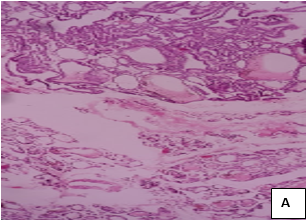
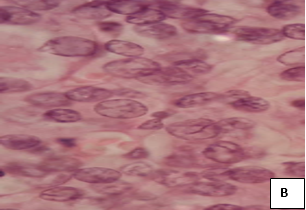
Figure 1: Microscopic appearance of papillary thyroid carcinoma. A: Papillary microcarcinoma adjacent to MNG areas (H&E, 20x). B: Nuclear features of papillary carcinoma characterized by nuclear inclusions and grooving along with ground glass appearance (H&E, 100x).
The incidence of carcinoma was higher in females with a female-to-male ratio of 5:1 in the present study. This finding is in accordance with the available literature, proposing thyroid carcinoma to be more common in females.4 The mean age of patients with thyroid malignancies was 39 ± 9 years. Qureshi et al. also reported maximum thyroid carcinomas in the same age group15. However a study done in Orleans, France recruited patients from an iodine deficient area. They reported a mean age of 55 ± 10 years for thyroid malignancies in patients undergoing thyroidectomy for MNG16.
The current study revealed an incidence of 8% carcinoma in MNG specimens. The incidence of thyroid malignancy in thyroidectomy specimens has been variously reported in the local data. An incidence of 7.6% and 8% has been reported by Memon et al. and Aurangzeb, respectively17, 18. Relatively higher incidences of 15% has been reported by Ullah et al19. A study from Multan, Pakistan documented malignancy incidence of 11% in thyroidectomy specimens20. A recent study conducted in New Zealand highlighted the rising incidence of unsuspected carcinoma in patients operated for MNG which accounted for 8% in non-toxic and 10% in toxic MNG21.
The current study revealed PTC as the most frequent (83.3%) malignancy followed by medullary carcinoma. There was no case of follicular carcinoma in the current study. These findings are more or less in line with a local published study showing papillary carcinoma as the most common malignancy (90%), followed by medullary carcinoma (4.5%) and follicular carcinoma (2%), respectively.6 An Indian study conducted in an endemic goiter region also had similar results22. Other studies have reported follicular carcinoma to be more frequent than medullary carcinoma10, 12. The absence of representation of follicular carcinoma might be due to the fact that these tumors clinically present as unifocal nodules3 while only multinodular thyroids were selected in the current study cohort.
In our study group, multifocal papillary carcinomas comprised of 60% cases in contrast to 44% multifocal malignancies isolated by Young et al23. The carcinomas did not measure beyond 2 cm in diameter. Also 50% were microcarcinomas, measuring not more than 1cm in diameter. Similar observations were found in another study24. All carcinomas observed in the current study were well-differentiated and early carcinomas. Gonzalez et al. studied the difference between clinically apparent thyroid carcinoma and incidental carcinoma. They found that incidental carcinomas were at the earlier biological stage and had a better prognosis with less mortality rates25.
Considering the incidental finding of thyroid carcinoma in MNG after histopathology, Keliszewski et al. proposed total thyroidectomy or near total thyroidectomy for MNG patients to avoid re-surgery26. Another study proposes a Dunhill procedure27. The suggested surgical options for well-differentiated thyroid carcinoma >1 cm is total or near total thyroidectomy whereas for a unifocal nodule measuring <1 cm, lobectomy will be sufficient 12 in the absence of other risk factors. Most of the cases observed in this study were multifocal and measured 1 cm or more, so a more radical procedure would decrease the need of reoperation in MNG patients.
Nguyen et al narrated that thyroid nodules measuring >1 cm must be evaluated for malignancy by ultrasound and FNAC10. In addition Knox also adds that nodules less than 1 cm should be followed by serial ultrasonography instead of FNAC evaluation. Also, multiple nodules necessitate the need for FNAC of these nodules10, 11. Multinodularity in thyroid on physical examination should not be considered as an indicator of a benign disease. Any thyroid enlargement should be fully investigated by ultrasound and FNAC. The neoplastic lesions observed in this study were not more than 2 cm in size and likely to be missed on palpation among the other nodules, in case of MNG. The probability of their detection on blind FNAC would be low. But 50% were more than 1 cm in size. These cases if investigated by preoperative ultrasound guided FNAC, would have yielded a positive diagnosis. Multicenter studies using preoperative ultrasound guided FNAC followed by histopathological detection of microcarcinomas in thyroids could further validate this study finding.
This study was conducted in a single tertiary care center and thyroid scans were not considered in making preoperative diagnosis of MNG as they were not performed on all patients. These are regarded as the major limitations of this study.
The clinical diagnosis of MNG is not an indicator of a benign process. Incidental carcinomas can be seen in thyroids operated for MNG. This study emphasizes the occurrence of incidental thyroid carcinomas in our settings and a need for strict adherence to a systematic approach in evaluating patients with thyroid enlargement. This should include ultrasound examination and FNAC, and when required an ultrasound guided FNAC. This calls for an intricate multidisciplinary coordination between the departments for better patient care.
- DeLellis RA, Lloyd RV, Heitz PU, Eng C, editors. Pathology and genetics of tumors of endocrine organs. In: Kleihues P, Sobrin LH, series editors. WHO Classification of Tumours. Lyon: IARC Press; 2004.
- Khan A, Nose V. In: Lloyd RV, editor. Endocrine pathology: differential diagnosis and molecular advances, 2nd ed. New York: Springer 2010; p. 181–236. Doi: 10.1007/978-1-4419-1069-1.
- Abboud B, Sader Ghorra C, Rassy M, El Naderi S, Trak-Smayra V, Abadjian G, et al. Epidemiological Study of Thyroid Pathology in a University Hospital. Acta Chir Belg. 2015; 115(6): 414–7. Doi: 10.1080/00015458.2015.11681143.
- Davies L, Welch HG. Current thyroid cancer trends in the United States. JAMA Otolaryngol Head Neck Surg. 2014; 140(4): 317–22. Doi:10.1001/jamaoto.2014.1.
- Zuberi LM, Yawar A, Islam N, Jabbar A. Clinical presentation of thyroid cancer patients in Pakistan--AKUH experience. J Pak Med Assoc. 2004; 54(10): 526-8. PMID 15552288.
- Bukhari U, Sadiq S, Memon J, Baig F. Thyroid carcinoma in Pakistan: a retrospective review of 998 cases from an academic referral center. Hematol Oncol Stem Cell Ther. 2009; 2(2): 345–8. Doi: 10.1016/S1658-3876(09)50023-4.
- Pezzolla A, Marzaioli R, Lattarulo S, Docimo G, Conzo G, Ciampolillo A, et al. Incidental carcinoma of the thyroid. Int J Surg. 2014; 12: S98–102. Doi: 10.1016/j.ijsu.2014.05.041.
- Pradhan GB, Shrestha R, Shrestha S, Neupane J, Bhattachan CL. The incidence of thyroid carcinoma in multinodular goiter: prospective study. Nepal Med Coll J. 2011; 13(3): 169–71. PMID 22808807.
- Mitchell AL, Gandhi A, Scott-Coombes D, Perros P. Management of thyroid cancer: United Kingdom National Multidisciplinary Guidelines. J Laryngol Otol. 2016; 130(S2): S150–60. Doi:10.1017/S002221511 6000578.
- Nguyen QT, Lee EJ, Huang MG, Park YI, Khullar A, Plodkowski RA. Diagnosis and treatment of patients with thyroid cancer. Am Heal drug benefits. 2015; 8(1): 30–40. PMID 25964831.
- Knox MA. Thyroid nodules. Am Fam Physician. 2013; 88(3): 193–6.
- Cooper DS, Doherty GM, Haugen BR, Kloos RT, Lee SL, Mandel SJ, et al. Revised American Thyroid Association management guidelines for patients with thyroid nodules and differentiated thyroid cancer. Thyroid. 2009; 19(11): 1167–214. Doi: 10.1089/thy. 2009.0110.
- Bombil I, Bentley A, Kruger D, Luvhengo TE. Incidental cancer in multinodular goitre post thyroidectomy. S Afr J Surg. 2014; 52(1): 5–9. Doi:10.7196/SAJS.1970.
- Miccoli P, Minuto MN, Galleri D, D’Agostino J, Basolo F, Antonangeli L, et al. Incidental thyroid carcinoma in a large series of consecutive patients operated on for benign thyroid disease. ANZ J Surgery. 2006; 76(3): 123-6. Doi: 10.1111/j.1445-2197.2006. 03667.x.
- Qureshi IA, Khabaz MN, Baig M, Begum B, Abdelrehaman AS, Hussain MB. Histopathological findings in goiter: A review of 624 thyroidectomies. Neuro Endocrinol Lett. 2015; 36(1): 48–52. PMID 25789588.
- Fama F, Sindoni A, Cicciu M, Polito F, Piquard A, Saint-Marc O, et al. Preoperatively undiagnosed papillary thyroid carcinoma in patients thyroidectomized for benign multinodular goiter. Arch Endocrinol Metab. 2018; 62(2): 139-48. Doi: 10.20945/2359-3997000000017.
- Memon W, Khanzada TW, Samad A, Kumar B. Incidence of thyroid carcinoma in multinodular goiters. Rawal Med J. 2010; 35(1): 65-7.
- Mahmud Aurangzeb SH. Total Thyroidectomy for benign bilateral multinodular goitre in an endemic region. Pak J Surg. 2006; 22(4): 195-200.
- Ullah I, Hafeez M, Ahmad N, Muahammad G, Gandapur S. Incidence of thyroid malignancy in multinodular goiter. J Med Sci. 2014; 22(4): 164–5.
- Waqar T, Younas S, Riaz F. Incidental thyroid carcinoma in multinodular goitre. Ann King Edward Med Uni. 2006; 12(4): 477–9. Doi: 10.21649/akemu.v 12i4.929.
- Karalus M, Tamatea JA, Conaglen HM, Meyer-Rochow GY, Conaglen JV, Elston MS. Rates of unsuspected thyroid cancer in multinodular thyroid disease. NZMJ. 2018; 131(1468): 69–74.
- Mathai AM, Preetha K, Devi SV, Vicliph S, Pradeep R, Shaick A. Analysis of Malignant Thyroid Neoplasms with a Striking Rise of Papillary Microcarcinoma in an Endemic Goiter Region. Indian J Otolaryngol Head Neck Surg. 2017; 71: 121-30. Doi: 10.1007/s12070-017-1156-8.
- Yong JS, Loh KS, Petersson BF, Thong M. Multinodular goiter: A study of malignancy risk in nondominant nodules. Ear Nose Throat J. 2017; 96(8): 336–40. Doi: 10.1177/014556131709600821.
- Pezzolla A, Lattarulo S, Milella M, Barile G, Pascazio B, Ciampolillo A, et al. Incidental carcinoma in thyroid pathology: our experience and review of the literature. Ann Ital Chir. 2010; 81(3): 165-9. PMID 21105480.
- González-Sánchez-Migallón E, Flores-Pastor B, Pérez-Guarinos CV, Miguel-Perelló J, Chaves-Benito A, Illán-Gómez F, et al. Incidental versus non-incidental thyroid carcinoma: Clinical presentation, surgical management and prognosis. Endocrinol Nutr. 2016; 63(9): 475-81. Doi: 10.1016/j.endoen.2016.10.008.
- Kaliszewski K, Strutyńska-Karpińska M, Zubkiewicz-Kucharska A, Wojtczak B, Domosławski P, Balcerzak W, et al. Should the prevalence of incidental thyroid cancer determine the extent of surgery in multinodular goiter? PLoS One. 2016; 11(12): e0168654. Doi: 10.1371/journal.pone.0168654
- Mauriello C, Marte G, Canfora A, Napolitano S, Pezzolla A, Gambardella C, et al. Bilateral benign multinodular goiter: what is the adequate surgical therapy? A review of literature. Int J Surg. 2016; 28: S7-12. Doi: 10.1016/j.ijsu.2015.12.041.

An Official Publication of
Islamabad Medical & Dental College
Volume 10 Issue 2
Author's Contribution:
1Conception; Literature research; manuscript design and drafting; 2,3 Critical analysis and manuscript review; 4-6 Data analysis; Manuscript Editing.
Article info:
Received: January 11, 2020
Accepted: May 4, 2021
Funding Source: Nil
Conflict of Interest: Nil
Address of Correspondence
Mudassira Zahid
Email:
mudassirazahid@gmail.com
Cite this article. Zahid M, Usman A, Tauseef k, Zaffar H, Niaz A, Khan N. Frequency of Incidental Carcinoma in Thyroids Operated for Multinodular Goiter. J Islamabad Med Dental Coll. 2021; 10(2): 110-115. Doi: 10.35787/jimdc.v10i2.487