Changing Antimicrobial Susceptibility and Resistance Pattern of Acinetobacter Species over the Last Eight Years in a Tertiary Care Hospital in Lahore, Pakistan
Fareeha Imran1, Muna Malik1, Amina Asif1, Gulnaz Akhtar2, Sidra Zaman3, Aasma Noveen Ajmal4
1 Assistant Professor, Department of Pathology, Ameer-ud-Din Medical College/PGMI/LGH, Lahore, Punjab Pakistan
2 Associate Professor, Department of Pathology, Ameer-ud-Din Medical College/PGMI/LGH, Lahore, Punjab Pakistan
3 Demonstrator, Department of Pathology, Avicenna Medical College, Lahore, Punjab Pakistan
4 Senior Demonstrator, Department of Pathology, Ameer-ud-Din Medical College/PGMI/LGH, Lahore, Punjab Pakistan
Background:
Acinetobacter spp. is a highly resistant nosocomial pathogen that leads to a broad range of human infections resulting in high morbidity and mortality. Due to unpredictable MDR patterns of Acinetobacter spp., it is imperative to know the institutional prevalent susceptibility profiles of these residing pathogens. The objective of this study was to determine the antimicrobial susceptibility pattern of Acinetobacter species over the last 8 years in a tertiary care hospital in Lahore, Pakistan.
Material and Methods: A retrospective study was carried out in Lahore General Hospital, a tertiary care hospital in Lahore, Pakistan. Eight-year data was gathered from January 2012 to December 2019. All specimens were handled according to standard operating procedures in the microbiology laboratory of the Pathology department of Lahore General Hospital. The Acinetobacter spp. were identified in the laboratory by Gram staining, oxidase test, catalase test and Triple sugar iron fermentation and their antibiotic sensitivity pattern was noted.
Results: The highest yield of Acinetobacter spp. from the clinical specimen was isolated from pus followed by tracheal secretion, blood, and urine in the last three years (from 2017 to 2019). Most of the isolates were multi-drug resistant (MDR). There was a progressive increase in resistance of Acinetobacter spp. The highest progression in resistance was observed among the cephalosporin and quinolone group of antibiotics.
Conclusions:Increased resistance to commonly used antimicrobials against Acinetobacter species has been observed with the highest resistance to quinolones and cephalosporins.
Key words: Acinetobacter, Antibiotic stewardship, Multidrug resistance, Nosocomial infections.
Acinetobacter species is one of the most important opportunistic non-fermenting bacteria associated with hospital-acquired infections with almost 20% of infections occurring in intensive care units1. It is a major cause of urinary tract infection, surgical site infection, septicemia, pneumonia, and ventilator-associated pneumonia. In the past, they were considered contaminants but now they are an important cause of healthcare-associated infections2. Hospital-acquired infections are the sixth leading cause of death in the USA3. Invasive procedures and misuse of broad-spectrum antibiotics are the major risk factors for the acquisition of infection with Acinetobacter species. Increased resistance leads to treatment failure, prolonged hospital stays, financial burden and increased mortality4, 5.
Multidrug efflux pumps, target modification, permeability defects, and enzymatic degradation of drugs are important mechanisms of acquired resistance against a wide range of antibiotics6. Acinetobacter species have been declared by WHO as one of the most serious organisms among ESKAPE pathogens (Enterococcus faecium, Staphylococcus aureus, Klebsiella pneumoniae, Acinetobacter species, Pseudomonas aeruginosa, and Enterobacter species)6.
It is very difficult to eradicate Acinetobacter from the environment due to its ability to survive on dry surfaces for a longer period and resistance to most of the disinfectants7. About 48-85% of the clinical isolates have shown multidrug resistance.1 Acinetobacter spp. are emerging as one the most resistant pathogens in Pakistan as well as globally and are a great burden to human health8, 9.
Increased incidence of MDR strains of Acinetobacter species is due to a lack of compliance with basic infection control measures8. Due to unpredictable MDR patterns of Acinetobacter spp., it is imperative to know the institutional prevalent susceptibility profiles of these residing pathogens. Hence, this study was conducted to observe the antibiogram of the last eight years of various clinical samples from which Acinetobacter spp. was isolated by a simplified phenotypic identification protocol and to determine the changing antibiotic susceptibility pattern of these isolates. This is essential for proper antimicrobial stewardship, which is the key to effective control of infections.
This retrospective study was carried out in Lahore General Hospital, Lahore, a tertiary care hospital. Approval was obtained from the Ethical Review Committee of Postgraduate Medical Institute/ Ameer-ud-Din Medical College/ Lahore General Hospital, Lahore, Pakistan. This study comprised of eight-year data from January 2012 to December 2019.
Samples from both indoor and outdoor patients were collected and processed according to standard protocols of the microbiology laboratory of the Pathology department, Lahore General Hospital, Lahore, Pakistan. These samples included blood, CSF, pus, wound swabs, tips, tracheal secretion, fluid, sputum, bronchial wash, pleural tap, tissue/biopsy, and urine. All Acinetobacter spp. isolated and identified after biochemical tests were included in this study.
Clinical samples from patients already taking antibiotics and repeat isolates from the same patient were excluded.
All clinical specimens were initially inoculated on a Blood agar and MacConkey agar, while the urine specimens were inoculated on Cystine Lactose Electrolyte Deficient (CLED) medium. The inoculated plates were incubated aerobically at 37°C and checked for bacterial growth after 24 hours. The morphology of bacterial colonies was examined with a hand lens. The bacteria were identified first by Gram staining, catalase test, oxidase tests, and hanging drop method for motility. The Acinetobacter spp. were identified as Gram-negative or Gram variable coccobacilli, oxidase negative and catalase positive. Each strain was inoculated on the Triple sugar iron (TSI) slant for the identification of its ability to ferment sugars.
The antimicrobial susceptibility pattern was evaluated by the Kirby-Bauer disc diffusion method according to respective CLSI guidelines10. A bacterial suspension of 0.5 McFarland turbidity standard was made and inoculated on Muller Hinton agar plate for each Acinetobacter spp. isolate. Aminoglycosides, Carbapenem, Quinolones, Cephalosporins. Ampicillin / Sulbactam, Cotrimoxazole, Piperacillin / Tazobactam, and Doxycycline discs were inoculated on plates and incubated for further 24 hours of aerobic incubation at 37°C.
ATCC 19606 strain of Acinetobacter species was used as a quality control strain in all standard operating procedures.11 Frequencies and percentages were calculated for the qualitative variables like Acinetobacter species isolated from clinical samples and percentage resistance pattern to various antibiotics.
The results were tabulated according to each year. A total number of clinical samples were tabulated from which Acinetobacter species were isolated according to the specimen.
The highest yield of Acinetobacter spp. from the clinical specimen was isolated from pus followed by tracheal secretion, blood, and urine in the last three years from 2017 to 2019 (Table I).
Figure 1 is showing the eight years resistance pattern in our settings with a progressive increase in resistance of Acinetobacter spp. The highest progression in resistance was observed among the cephalosporin and quinolone groups of antibiotics
Despite rigorous endeavors, nosocomial multi-drug resistant (MDR) Acinetobacter spp. is still a major problem owing to its great capability to propagate and colonize human and environmental reservoirs. Acinetobacter spp. is a highly resistant nosocomial pathogen that leads to a broad range of human infections resulting in high morbidity and mortality rates.12 Over the years Acinetobacter species are increasingly being isolated from a broad array of clinical specimens. It is the need of the day to periodically analyze the antimicrobial susceptibility and resistance pattern of this common pathogen so that appropriate antibiotic policy can be formulated for empirical as well as a targeted treatment.
The variations in the antibiogram of Acinetobacter spp. demands periodic surveillance of these pathogens for an appropriate selection of therapy13.
Acinetobacter species has attained a foothold in the ICU settings, causing nosocomial pneumonia which accounts for around 36% of hospital-acquired pneumonia in Asian countries.14,15 This is in concordance with this study, which shows Acinetobacter species infections on the rise over the past eight years, especially in the ICUs. This is an imminent threat for the spillover of this organism in the general wards, highlighting the importance of keeping a strict eye over its prevalence and antimicrobial susceptibility and resistance pattern.
Analysis of antibiograms of Acinetobacter species over the last eight years in our hospital has unveiled some interesting findings. An increased pattern of antimicrobial resistance has been reported in a tertiary care hospital in Nepal with 100% resistance to cephalosporins16. These observations indicated that cephalosporins are no more a drug of choice for effective treatment of Acinetobacter infections17. This is an alarming situation as our study also shows cephalosporin resistance on the rise over the last eight years with resistance reaching up to almost 100%. The carbapenems are considered salvage therapy for most multidrug-resistant organisms. However, the emergence of carbapenemase enzymes is a worldwide phenomenon narrowing the available spectrum of antimicrobials for the treatment of MDR Acinetobacter species18. The present study showed approximately 60% resistance to carbapenems which are also very alarming for clinically isolated Acinetobacter spp. in the tertiary care hospital.
Table I: Yearly distribution of growth of Acinetobacter spp. isolated from different clinical specimens |
|||||||||
Specimen |
2012 |
2013 |
2014 |
2015 |
2016 |
2017 |
2018 |
2019 |
n |
Blood |
28 |
22 |
29 |
38 |
32 |
152 |
161 |
257 |
719 |
CSF |
7 |
31 |
27 |
30 |
42 |
61 |
98 |
187 |
483 |
Pus |
44 |
48 |
54 |
57 |
56 |
198 |
390 |
407 |
1245 |
Tracheal secretion |
-- |
2 |
1 |
17 |
32 |
207 |
312 |
478 |
1049 |
Sputum |
-- |
7 |
3 |
-- |
4 |
30 |
37 |
42 |
123 |
Wound swab |
-- |
5 |
2 |
28 |
24 |
69 |
85 |
76 |
289 |
Bronchial wash |
-- |
|
-- |
-- |
8 |
8 |
7 |
5 |
28 |
Fluid |
-- |
-- |
-- |
9 |
8 |
19 |
13 |
25 |
74 |
Tips |
-- |
4 |
2 |
17 |
48 |
76 |
95 |
76 |
218 |
Pleural tap |
-- |
-- |
-- |
-- |
-- |
2 |
4 |
7 |
13 |
Urine |
11 |
6 |
15 |
38 |
92 |
143 |
170 |
206 |
681 |
Tissue/ biopsy |
-- |
-- |
-- |
-- |
2 |
21 |
30 |
56 |
109 |
Total organisms isolated |
90 |
126 |
133 |
234 |
348 |
986 |
1438 |
1822 |
5140 |
n-total number of specimens; CSF-Cerebrospinal fluid.
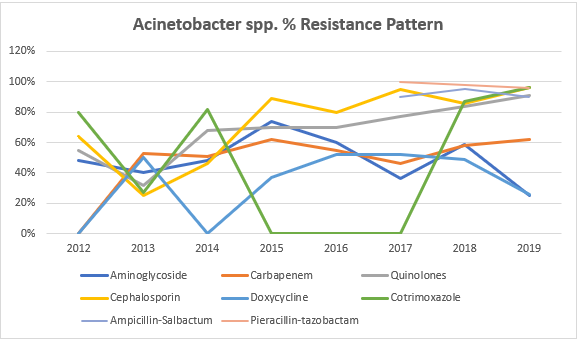
* 0% values show the antibiotic discs were not available in these years
Figure 1: Eight-year percentage resistance pattern of different groups of Antibiotics to Acinetobacter spp.
Another alarming finding is the rise of antimicrobial resistance to quinolones reaching up to 90% in the year 2019. Elshahat et al. and Roy et al. commented in their recent studies on quinolones resistance in clinical isolates of Acinetobacter spp. According to them, quinolones resistance is more than 90% among Acinetobacter isolates, which is consistent with the present study19, 20.
An interesting finding of our study is a revival of antimicrobial susceptibility to Doxycycline. Sadhu et al. reported that Doxycycline has good efficacy against MDR Acinetobacter spp., and its use can be considered as an alternative therapy to down-regulate the pressure on other groups of antibiotics21. Therefore, the sensitive pattern of doxycycline in our hospital settings would be a good sign for treating nosocomial infections.
This may be due to the phenomenon of antibiotic holidays and holds a promising perspective for other antibiotics as well. This can contribute to the appropriate institution of antimicrobial stewardship which involves giving the right antibiotic, at the right time, in the right dose, and for an appropriate period. Observing antibiotic holidays stepwise for other groups of antibiotics may lead to a revival of their susceptibility and hence clinical effectiveness.
The progressively increasing trend of antimicrobial resistance in Acinetobacter species to major groups of antibiotics over the last eight years is an eye-opener for our hospital as well as for antibiotic policymaking. It is high time that all tertiary care hospitals maintain and publish yearly antibiograms, as this is an essential component of antimicrobial stewardship.
The current antibiogram of Acinetobacter species revealed the progressively increasing resistance of this hospital bug which is now posing a great threat to patients in hospital settings. Judicial use of antibiotics by clinicians should be ensured to maintain an antibiotics stewardship program.
We recommend every tertiary care hospital maintain its hospital antibiograms. This will help to maintain antibiotic stewardship in their hospital settings according to their local trend of antibiotic resistance. We also recommend following strict infection prevention and control programs to overcome antibiotic resistance among local hospital nosocomial bacteria.
We acknowledge Dr. Iffat Javed, Professor of Pathology, for guiding us in the making of antibiograms
- Fayyaz M, Khan IU, Hussain A, Mirza IA, Ali S, Akbar N. Frequency and antimicrobial susceptibility pattern of acinetobacter species isolated from pus and pus swab specimens. J Coll Physicians Surg Pak. 2015; 25(5): 346-9. PMID: 26008660.
- Sarkar M, Jena J, Pattnaik D, Mallick B. Prevalence of nonfermentative gram-negative bacilli and their antimicrobial susceptibility profiles in a tertiary hospital of Eastern India. Int J Advances Med. 2018; 5(2): 366-70. Doi: 10.18203/2349-3933.ijam20181070.
- Begum S, Hasan F, Hussain S, Shah AA. Prevalence of multi drug resistant Acinetobacter baumannii in the clinical samples from Tertiary Care Hospital in Islamabad, Pakistan. Pak J Med Sci. 2013; 29(5): 1253-58. Doi: 10.12669/pjms.295.3695.
- Vaja K, Kavathia GU, Goswami YS, Chouhan S. A prevalence study of Acinetobacter species and their sensitivity patter in a tertiary care hospital Rajkot city of Gujrat (India): A hospital based study. IOSR J Dent Med Sci. 2016; 15(7): 54-8. Doi:10.9790/0853-150765458.
- Odsbu I, Khedkar S, Khedkar U, Nerkar SS, Tamhankar AJ, Stålsby Lundborg C. High proportions of multidrug-resistant Acinetobacter spp. isolates in a district in Western India: a four-year antibiotic susceptibility study of clinical isolates. Int J Environ Res Public Health. 2018; 15(1): 153. Doi: 10.3390/ijerph15010153.
- Lee CR, Lee JH, Park M, Park KS, Bae IK, Kim YB, et al. Biology of Acinetobacter baumannii: pathogenesis, antibiotic resistance mechanisms, and prospective treatment options. Front Cell Infect Microbiol. 2017; 7: 55. Doi: 10.3389/fcimb.2017.00055.
- Chandra P, Mittal V, Chaturvedi R. Isolation, Characterization and Antibacterial Susceptibility test of Acinetobacter species obtained from Tertiary Care Hospital. Int J Curr Microbiol App Sci. 2017; 6(2): 1279-86. Doi: 10.20546/ijcmas.2017.602.144.
- Chatterjee N, Dam S. Epidemiological study of Acinetobacter baumannii and its resistance pattern in clinical isolates from a private hospital in Kolkata, Eastern India. Int J Curr Res Life Sci. 2018; 7(05): 2001-3.
- Juyal D, Prakash R, Shanakarnarayan SA, Sharma M, Negi V, Sharma N. Prevalence of non-fermenting gram negative bacilli and their in vitro susceptibility pattern in a tertiary care hospital of Uttarakhand: A study from foothills of Himalayas. Saudi J Health Sci. 2013; 2(2): 108-12. Doi: 10.4103/2278-0521.117915.
- National Committee for Clinical Laboratory Standards. Performance Standards for Antimicrobial Susceptibility Testing. Clinical and Laboratory Standards Institute; 2017.
- Lob SH, Hoban DJ, Sahm DF, Badal RE. Regional differences and trends in antimicrobial susceptibility of Acinetobacter baumannii. Int J Antimicrob Agents. 2016; 47(4): 317-23. Doi: 10.1016/j.ijantimicag.2016.01.015.
- Qi L, Li H, Zhang C, Liang B, Li J, Wang L, et al. Relationship between antibiotic resistance, biofilm formation, and biofilm-specific resistance in Acinetobacter baumannii. Front Microbiol. 2016; 7: 483. Doi: 10.3389/fmicb.2016.00483.
- Sahu R, Pradhan CS, Swain B, Panigrahy R, Sahu MC. Surveillance of Acinetobacter spp. and drug sensitivity pattern in an Indian Tertiary Care Teaching Hospital. Int J Pharm Sci Rev Res. 2016; 39(1): 203-7.
- Garnacho-Montero J, Timsit JF. Managing Acinetobacter baumannii infections. Curr Opin Infect Dis. 2019; 32(1): 69-76. Doi: 10.1097/QCO.0000000000000518.
- Chung DR, Song JH, Kim SH, Thamlikitkul V, Huang SG, Wang H, et al., Asian Network for Surveillance of Resistant Pathogens Study Group. High prevalence of multidrug-resistant nonfermenters in hospital-acquired pneumonia in Asia. Am J Respir Crit Care Med 2011; 184(12): 1409–17. Doi: 10.1164/rccm.201102-0349OC.
- Joshi PR, Acharya M, Kakshapati T, Leungtongkam U, Thummeepak R Sitthisak S. Co-existence of blaOXA-23 and blaNDM-1 genes of Acinetobacter baumannii isolated from Nepal: Antimicrobial resistance and clinical significance. Antimicrob Res Infect Control. 2017; 6(21): 01- 07. Doi: 10.1186/s13756-017-0180-5.
- Manchanda V, Sanchaita S, Singh NP. Multidrug resistant Acinetobacter. J Glob Infect Dis. 2010; 2(3): 291-304. Doi: 10.4103/0974-777X.68538.
- Khanal BR, Wagle S, TiwaRi BR. Biofilm formation and colistin susceptibility of clinical isolates of Acinetobacter species in a tertiary care hospital of Nepal. National J Lab Med. 2019; 8(1): 12-5. Doi: 10.7860/NJLM/2019/38143:2335.
- Elshahat M, Aboelized E, Abd El Rahman R, Nabil M, Yassin A. Association between mutations in GYR A/B and PAR C/E genes of Acinetobacter Baumannii clinical isolates and Fluoroquinolones resistance. Microbes and Infectious Diseases. 2021; 2(2): 343-51. Doi: 10.21608/MID.2021.64414.1127.
- Roy S, Chatterjee S, Bhattacharjee A, Chatterjee P, Saha B, Dutta S, et al. Overexpression of efflux pumps, mutations in the pumps’ regulators, chromosomal mutations and aac6’Ib-cr are associated with fluoroquinolone resistance in diverse sequence types (STs) of neonatal septicaemic Acinetobacter baumannii: A 7-year single centre study. Front Microbiol. 2021; 12: 602724. Doi: 10.3389/fmicb.2021.602724.
- Sandhu R, Dahiya S, Sayal P. Evaluation of multiple antibiotic resistance (MAR) index and Doxycycline susceptibility of Acinetobacter species among inpatients. Indian J Microbiol Res. 2016; 3(3): 299-304.

An Official Publication of
Islamabad Medical & Dental College
Volume 10 Issue 2
Author's Contribution:
Conception; Literature research; manuscript design and drafting; 2,3 Critical analysis and manuscript review; 4-6 Data analysis; Manuscript Editing.
Article info:
Received: October 5,2020
Accepted: June 15, 2021
Funding Source: Nil
Conflict of Interest: Nil
Address of Correspondence
Fareeha Imran
Email:
fareehaimran536@hotmail.com
Cite this article. Imran F, Malik M, Asif A, Akhtar G, Zaman S, Ajmal A N. Changing Antimicrobial Susceptibility and Resistance Pattern of Acinetobacter Species over the Last Eight Years in a Tertiary Care Hospital in Lahore, Pakistan. J Islamabad Med Dental Coll. 2021; 10(2): 83-88. Doi: 10.35787/jimdc.v10i2.615