The Spectrum of Biochemical Changes in Thyroid Function Tests, Performed at Sahiwal Medical College, Sahiwal
Maryam Rafiq1Amna Arooj2Ayesha Siddiqa3Nudrat Fayyaz4Sara Khan5Rabia Saeed6
1Assistant Professor, Department of Chemical Pathology, Sahiwal Medical College, Sahiwal, Pakistan
2Assistant Professor, Department of Pathology, Sahiwal Medical College, Sahiwal, Pakistan
3Assistant Professor, Department of Pathology, Pakistan Institute of Medical Sciences, Islamabad, Pakistan
4Associate Professor, Department of Pathology, Multan Medical & Dental College, Multan
5Assistant Professor, Department of Chemical Pathology, CMH Institute of Medical Sciences, Bahawalpur
6Assistant Professor, Department of Pathology, CMH Institute of Medical Sciences, Bahawalpur
Objective: Thyroid disorders are among one the leading causes of endocrine problems worldwide. Hypothyroidism is very common and usually is more prevalent in females. Thyroid function tests (TFTs) play a vital role in the diagnosis and monitoring of thyroid disease. To assess the Spectrum of Biochemical Changes in Thyroid Function Tests
Methodology:This cross-sectional study was conducted at Sahiwal Medical College, Sahiwal after approval from the Institutional review board. The results of 2281 specimens tested for TFTs in the Pathology laboratory between August 2018 to December 2020 were included. Samples were analyzed by immunochemiluminescent assay method on an Access 2 analyzer by Beckman Coulter. Data were analyzed using Statistical Package for the Social Sciences (SPSS) version 25. A chi-square test was applied. P-value <0.05 was considered significant.
Results:A total of 2281 patient data was included in the study. The mean age of participants was 38.86±15.30 years and the majority were females. 64.1% of results were within the normal limit (euthyroid) while the remaining 35.9% had abnormal thyroid profiles. Hyperthyroidism was the most common abnormality (9.5%) followed by subclinical hypothyroidism (8.9%). Chi-square test revealed a statistically significant difference in age groups, with p-value of 0.004.
Conclusion: Thyroid diseases are quite common. Hyperthyroidism is slightly more prevalent than hypothyroidism in our community.
Key words:Hypothyroidism, Hyperthyroidism, Thyroid disorders, Subclinical thyroid disease.
Endocrine disorders, particularly thyroid gland abnormalities, are quite common.1,2 Thyroid disorders account for 30 to 40 % of patients in the endocrine practice, thereby significantly adding to the global burden of endocrine diseases.3 The thyroid gland, one of the vital glands, produces hormones; triiodothyronine (T3) and thyroxine (T4), which regulate the metabolism, growth, and various vital functions of the body. Any imbalance in thyroid hormones has an impact on the entire body and also affects the growth and well-being of an individual.4,5 Along with clinical examination, Thyroid function tests (TFTs) play a vital role in diagnosing and monitoring thyroid disease6,7.
Thyroid dysfunctions can broadly be classified as hyperthyroidism or hypothyroidism. Patients can present either with subclinical or overt disease.4 Hyperthyroidism is a catabolic state in which there is elevated T3 and T4, while in hypothyroidism there is an insufficient level of thyroid hormones. Both of these conditions are associated with many sclinical effects on the body like coronary artery disease, dyslipidemia, arrhythmias, and many more.1,4
American Association of Clinical Endocrinologists reported that around 13 million or 4.78% of people have an overt or subclinical thyroid disorder. In a global scenario, Hypothyroidism is more common than hyperthyroidism.3 Iodine deficiency is the commonest cause of thyroid dysfunction while in areas with sufficient iodine supplementation, autoimmune thyroiditis, and Hashimoto thyroiditis are common causes of hypothyroidism1. According to one estimate, iodine deficiency affects over 2.5 billion individuals globally, with 313 million residing in Southeast Asia, including Pakistan.5 Common causes of hyperthyroidism are Graves’s disease, multinodular goiter, and toxic adenoma. Rarely, it may be due to subacute thyroiditis.
It is also evident from studies that thyroid issues are more common in females than in males in Pakistan and around the world.1,3
Current evidence highlights the need to understand the prevalence and the factors governing it. There is a paucity of national data about biochemical changes in thyroid function tests (TFTs). The purpose of this study was to examine the frequency of abnormalities in thyroid function tests, in the people of Sahiwal district presented to Sahiwal Medical College laboratory for evaluation of thyroid hormones and to also determine the gender distribution of these disorders. This will help to know the frequency of these disorders in the local population and will raise awareness among clinicians dealing with these issues.
The cross-sectional study was conducted at SLMC, Sahiwal after approval from the Institutional review board of Sahiwal Medical College. In total 2281 specimens tested for TFTs in the laboratory between August 2018 to December 2020 were included in the study. Serum concentrations of thyrotropin, total triiodothyronine, and total thyroxine were measured using the immunochemiluminescent assay method on the Access 2 analyzer. For interpretation, the results of the thyroid function tests were classified into six categories: Euthyroid, subclinical hypothyroidism, overt hypothyroidism, sub-clinical hyperthyroidism, overt hyperthyroidism, and Equivocal. Data were analyzed using Statistical Package for the Social Sciences (SPSS) version 25. Descriptive statistics were applied to determine the frequency and percentages of qualitative variables like age groups, gender, and biochemical diagnosis. Mean and SD was calculated for numerical variables. A chi-square test was applied. P-value <0.05 was considered significant.
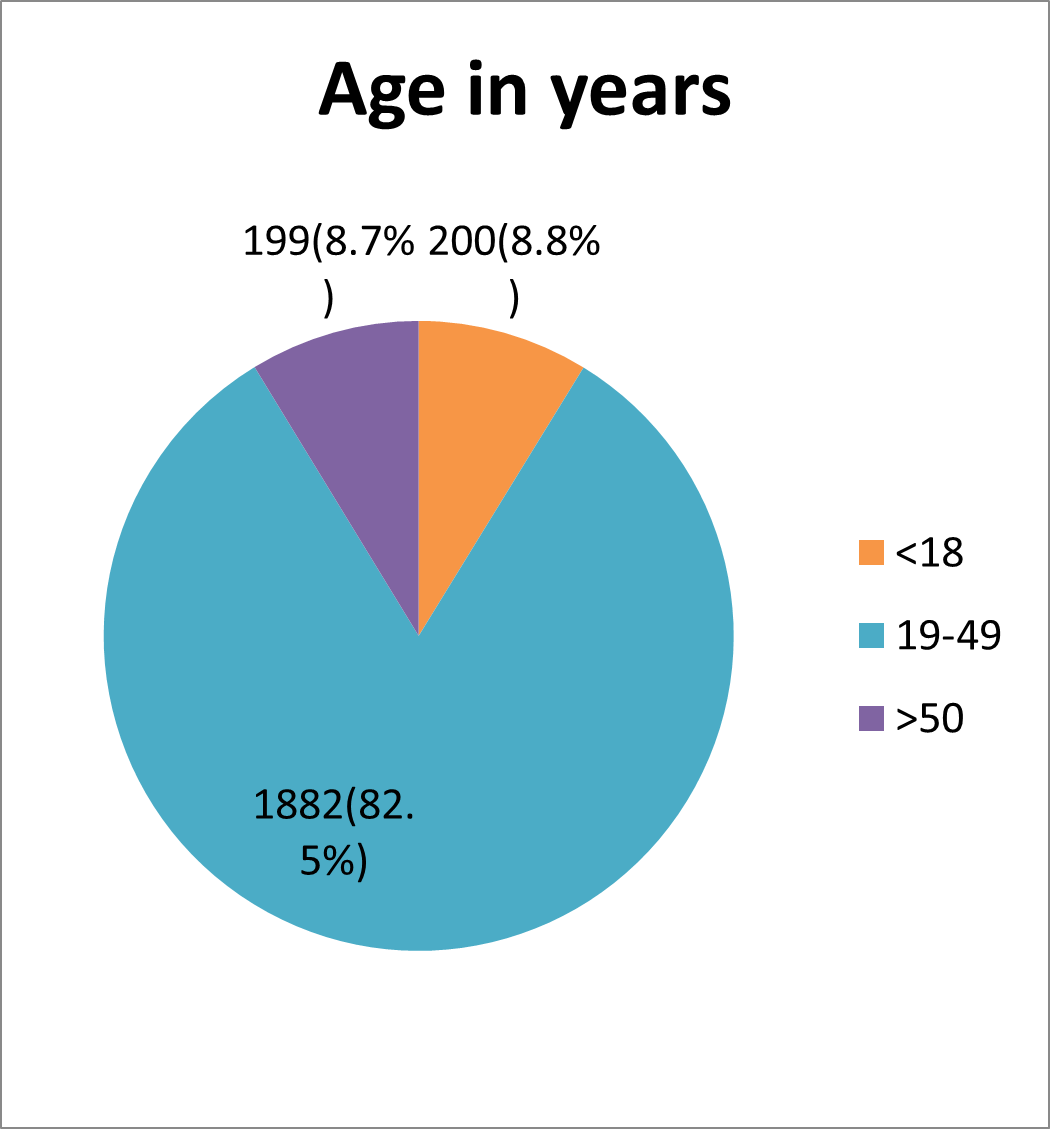
A total of 2281 patients’ data was included in the study, among which majority were females (84.7%). Most of the patients were adults with a mean age of 38.86±15.30 years. The age distribution is shown in Figure 1 below. Data from 64.1% of patients revealed a normal thyroid profile(euthyroid) while the remaining 35.9% had an abnormal thyroid profile. The cumulative frequency of hypothyroid disease was slightly higher than that of hyperthyroid disease, as shown in Table no 1. The results of the cross-tabulation of age with the biochemical diagnosis is illustrated in Table 2 which indicated that thyroid disorders were more prevalent in the age group 18-50 years. Hyperthyroidism was the most common abnormality (9.5%) followed by subclinical hypothyroidism (8.9%). The Chi-square test revealed a statistically significant difference in age groups, with a P-value of 0.004. Thyroid disorders were also evaluated concerning gender. difference between males and females was found to be statistically non-significant (table 3).
Thyroid disturbances are fairly common but the data about their prevalence in the Sahiwal district is quite limited.8 They frequently remain undiagnosed because of variable clinical manifestations and lack of uniform recommendations on the screening and diagnosis of thyroid problems.9 Thyroid function tests play a vital role in diagnosing and monitoring thyroid disorders.6
The current study included the data of 2281 patients. The majority of the participants were females, and the occurrence of abnormal thyroid function tests was also higher in females as compared to males. These findings agree with a few studies conducted locally and in neighboring countries like India.1,10 Various studies conducted in Saudi Arabia and India also revealed concordant results. 11,12,13
Most of the participants belonged to the adult age group (18 to 50 years). It was reported that both hypothyroidism and hyperthyroidism are more common in adults than in extreme ages.14 Similar findings were observed in a study conducted in Europe.15
When the results of TFTs were studied, the most common biochemical abnormality was Hyperthyroidism. 9.5% of subjects had hyperthyroidism followed by subclinical hypothyroidism (8.9%), subclinical hyperthyroidism (7.9%), and hypothyroidism (6.4%), respectively. In Indian research, 2.5% of the participants were overtly hyperthyroid, whereas 5.97% were subclinically hyperthyroid.8 Similarly, according to a study in Pakistan, hyperthyroidism and subclinical hyperthyroidism were found to be present in 5.1% and 5.8% of the population, respectively.16 These results are slightly lower than what we found in our research. In our study prevalence of subclinical hypothyroidism is 7.9%, while overt hypothyroidism is 6.4%. A study from India reported subclinical
hypothyroidism in 9.44% of patients. These are quite like the present study.8
When the sum of overt and subclinical disease was calculated, 17.4% had hyperthyroidism while 15.3% cases had hypothyroidism, though the difference was not statistically significant. In contrast to current results, Hypothyroidism is a more frequent thyroid disorder. A study conducted in India by Maurya H reported that hypothyroidism was observed in the maximum number of patients.17 Two more studies from India by Jaikhai et al and Deokar et al also reported similar findings.8,10 Studies from Pakistan also indicated that hypothyroidism is more prevalent in Pakistan. A study reported that around 60% of the cases of thyroid disorder are of hypothyroidism.14 Whereas results of some studies are not comparable e.g. Abdullah et al showed a slight predominance of hyperthyroidism.1 Another study from Gujranwala also had similar findings, with hyperthyroidism being more common.5 An Indian study also has similar findings.10 A study from Peshawar reported 13.17% of cases had hyperthyroidism followed by 11.3% cases of hypothyroidism.1 Findings reported in a study conducted in Peshawar’s study is in agreement with the current study. Variability in results may be due to regional variation, diet differences, and iodine supplementation. As observed from the literature, thyroid disorders have regional variation and their prevalence is also affected by diet, iodine supplementation, medication, and exposure to radiation, etc.18 An association of thyroid problems with different illnesses has been established by many studies like coronary artery disease, lipid disorder, arrhythmia, heart disease, and skin disorder.3
One important finding in the current study was that out of 2281, the results of 1462 (64.1%) patients tested for TFTs were within normal limits. Similar findings were seen in an Indian study that showed 59.64% of total patients had a normal thyroid profile.10 However another prevalence study in India reported 84.65% of the result as euthyroid.19 This high percentage of normal TFTs, though is in concordance with previously reported results but is not in agreement with the current study.9 It is suggested that when referring a patient for thyroid evaluation, symptom complexity should be kept in mind, considering one or two symptoms may result in undue testing and normal results. It will not only add financial burden but will also create disease anxiety in patients.
Thyroid disorders are not infrequent in our community. Females are more affected than males. Hyperthyroidism is a slightly more common disorder in Sahiwal. There is a dire need to redefine the case description of thyroid disorders and a rational and cost-effective approach should be employed in ordering TFTs.
- Attaullah S, Haq BS, Muska M. Thyroid dysfunction in khyber pakhtunkhwa, Pakistan. Pak J Med Sci. 2016;32(1):111-115. doi: 10.12669/pjms.321.8476. Crafa A, Calogero AE, Cannarella R, Mongioi LM, Condorelli RA, Greco EA, et al. The Burden of Hormonal Disorders: A Worldwide Overview with a Particular Look in Italy. Front Endocrinol. 2021;16(12):745. doi:10.3389/fendo.2021.694325
- Shah N, Ursani TJ, Shah NA, Raza HM. Prevalence and Manifestations of Hypothyroidism among Population of Hyderabad, Sindh, Pakistan. Pure Appl. Biol. 2021; 10(3):668-675.
- Anandkumar S, Chacko J, Usha M. Thyroid Disorder: An Overview. Research Journal of Pharmacology and Pharmacodynamics. 2020;12(1):1-4. Soh SB, Aw TC. Laboratory testing in thyroid conditions-pitfalls and clinical utility. Annals of laboratory medicine. 2019; 39(1): 3-14.
- Alzahrani AS, Al Mourad M, Hafez K, Almaghamsy AM, Alamri FA, Al Juhani NR et al. Diagnosis and Management of Hypothyroidism in Gulf Cooperation Council (GCC) Countries. Adv Ther. 2020; 37:3097-3111. doi: 10.1007/s12325-020-01382-2
- Aljabri KS, Alnasser IM, Facharatz BS, Alshareef MA, Khan PM, Mallosho AM et al. The frequency of hypothyroidism in Saudi community-based hospital: a retrospective single center study. Trends Diabetes Metab. 2019; 2(1):1-4. DOI:10.15761/TDM.1000107
- Taylor PN, Albrecht D, Scholz A, Gutierrez-Buey G, Lazarus JH, Dayan CM et.al. Global epidemiology of hyperthyroidism and hypothyroidism. Nat Rev Endocrinol. 2018 May;14(5):301-16. https://doi.org/10.1038/nrendo.2018.18.
- Maurya H. Thyroid function disorders among the Indian population. Ann Thyroid Res. 2018; 4:172-3. DOI:10.26420/annalsthyroidres.2018.1044.
- Bose A, Sharma N, Hemvani N, Chitnis DS. A hospital-based prevalence study on thyroid disorders in Malwa region of Central India. Int J Curr Microbiol App Sci. 2015;4(6):604-11.
An Official Publication of
Islamabad Medical & Dental College
Volume 12 Issue 4
Editorial
Address of Correspondence
Maryam Rafiq
Email:
mariamsheikh15@yahoo.com
Cite this article.Rafiq M, Arooj A, Siddiqa A, Fayyaz N, Khan S, Saeed R. The Spectrum of Biochemical Changes in Thyroid Function Tests, Performed at Sahiwal Medical College, Sahiwal .J Islamabad Med Dental Coll. 2023; 12(2): 122-126 DOI: https://doi.org/10.35787/jimdc.v12i2.842