Evaluation of the Occlusal Contact between the Opposing Teeth and the Cusp of Carabelli in Maxillary Permanent First Molars in Patients Visiting Peshawar Dental College
Sana Arbab 1 ,Munawar Aziz Khattak 2 ,Imran Khattak 3,Yusra Jamil 4,Faiza Ijaz 5,Ambereen Hamayun 6
1Assistant Professor, Department of Oral Biology, Peshawar Dental College, Peshawar- Pakistan
2Associate Professor, Department of Oral Biology, Peshawar Dental College, Peshawar- Pakistan
3Assistant Professor, Department of Oral Biology, Peshawar Dental College, Peshawar- Pakistan
4Assistant Professor, Department of Oral Biology, Rashid Latif Medical and Dental College, Lahore- Pakistan
5Assistant Professor, Department of Oral Biology, Ayub College of Dentistry, Abbottabad,Pakistan
6Assistant Professor, Department of Anatomy, Peshawar Medical College, Peshawar- Pakistan
Background:The Cusp of Carabelli is a small additional cusp which is situated on the mesiopalatal surface of first maxillary molars. This nonfunctional cusp comes in many forms including furrows, ridges or pits and is collectively known as the Carabelli trait
Objective: To evaluate the frequency of the occlusal contacts between the accessory cusp of Carabelli and the opposing arch tooth among both genders in patients attending the out-patients department of Peshawar Dental Hospital, Peshawar
Methodology:This descriptive cross-sectional study was conducted on 300 subjects visiting the OPD of Peshawar Dental Hospital from October 2022 to December 2022. The sample size was calculated using WHO formula N=p(100-p)z2/d2 (Http://www.fao.orgThe age group selected for the participants was from 13-30 years. Consecutive sampling technique was used.). Articulating paper was used to assess the occlusal contacts caused by the cusp of Carabelli. The data were analyzed using SPSS version 20. Pearson’s chi square test was applied to analyze the data. P value of ≤ 0.05 was considered statistically significant.
Results: The results of the current study showed that 10.7% of the participants experienced occlusal contacts caused by the presence of their accessory cusp with the opposing arch tooth with no statistically significant difference between genders.
Conclusion: The cusp of Carabelli is the most prevailing variation found on the palatal aspect of mesiopalatal cusp of permanent maxillary first molars in a hospital-based inhabitants of Peshawar with rare occlusal contacts experienced by the patients.
Key words:Cusp of Carabelli, Maxillary permanent first molars, Occlusal contact.
Morphological variations exist in both primary and permanent teeth which can be expressed in crown and roots.1,2 Accessary cusps including cusp of Carabelli, Talon cusp, central cusp, Leong’s tubercle are the frequent occurrences.2,3 Cusp of Carabelli account for 52-68% in molars more frequently maxillary first molars and is located lingual to the mesiopalatal cusp of maxillary first permanent molars.4 It may also be found in second and third molars but less frequently.4
The development of this cusp is usually attributed to certain genetic or environmental factors however the exact etiology is unknown and these accessory cusps are attributed to different growth patterns.5 Moreover the occurrence of the cusp of Carabelli may be due to the overactivity of dental lamina due to a genetic influence.6 Its size ranges from a large prominent cusp to a rudimentary eminence.7 Certain vitamins, nutrients or size of the jaws may also contribute to the development of this cusp.8
A study conducted in Mardan showed that 32% of the study population had cusp of Carabelli on permanent maxillary first molars.9 Another study conducted on a local population of Peshawar showed an overall frequency of the cusp of Carabelli to be 39.3% in permanent maxillary first molars.10
The clinical significance of cusp of Carabelli and other accessory cusps is that they may cause some clinical disturbances such as occlusal interferences, esthetic problems, accidental cusp fracture, carious lesion in cusp of Carabelli groove and irritation of tongue during speech and mastication etc.11,12 The occlusal contacts between the accessory cusps and opposing teeth cause attritional wear which are characterized by smooth and polished delineated areas known as wear facets.13 Moreover, these occlusal contacts occur when the maxillary molars occlude with the lingual slopes of mandibular molars.14 These premature contacts caused by the accessory cusps occur because of their abnormal morphology and location.15 Adequate assessment of occlusion is necessary for achieving proper mastication and functioning of masticatory apparatus. However, any irregular occlusal contacts can lead to various clinical symptoms such as migration of teeth, cracked enamel, gingival recession, fracture of restorations or prosthesis, diseases of TMJ and orofacial pain. 16 The occlusal contacts can be clinically detected by two methods such as by using articulating papers or waxes and impression materials. 17
The main objective of the study was to determine the frequency of the occlusal contacts between the accessory cusp of Carabelli and the opposing arch tooth among both genders in patients coming to the OPD of Peshawar Dental Hospital, Peshawar
This cross-sectional was conducted in Peshawar Medical & Dental College from October 2022 to December 2022. A total of 300 patients were included in the study through convenient sampling technique. The sample size was calculated using WHO formula N=p(100-p)z2/d2 (Http://www.fao.org). Approval of the study was done by Ethical Review Committee of Peshawar Medical & Dental College. All the included participants were informed (written consent: Annexure B) about the purpose of the study. Two teeth per patient (600 in total) were examined. Inclusion criteria set for the study was: both genders having complete eruption of permanent maxillary first molars bilaterally, age group 13-30 years, sound non-carious, no attrition or erosion or any dental disease deteriorating the morphology of permanent maxillary first molars were included in the study. Patients having any congenital dental disease, carious or restored permanent maxillary first molars detected clinically delineating their morphology or any prosthesis/orthodontic appliance on maxillary permanent first molars were excluded. A proforma (Annexure A) was made to document the data of patients. An intraoral examination of the participants’ permanent maxillary first molars was carried out by seating them in dental chair under proper illumination and assessing the teeth with the help of mouth mirror. Dental explorer was used to detect any carious lesion on maxillary permanent first molars. All the observations were made by the author herself and no other observer was involved thus excluding interobserver variability. Articulating paper was placed between the mesiopalatal surface of maxillary permanent first molars and the occlusal surface of mandibular first molars to detect occlusal contact caused by the cusp of Carabelli and the patients were instructed to bite on the paper while opening and closing the jaws (centric relation). Articulating paper was then removed and the teeth were evaluated. A mark on the cusp of Carabelli or opposing arch tooth left by the paper indicated that the cusp does have contact with the opposing tooth of the patient. In case the paper left no mark showed that the cusp of Carabelli did not interfere with occlusion. The data were analyzed using SPSS version 22. Pearson’s ChiSquare test was used for data analysis. A p-value ≤ 0.05 to be considered statistically significant.
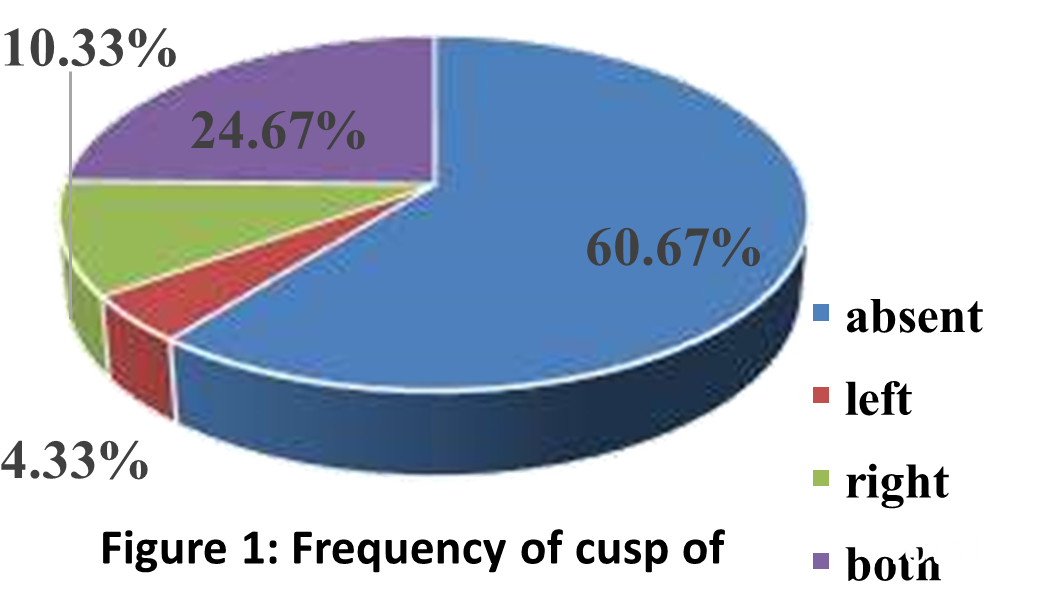
Out of 300 participants, males accounted for 125 (41.7%) while females were 175 (58.3%) in number. The total number of teeth examined were 600 (two maxillary permanent first molars per patient). The candidates fell in age group 13-30 years having a mean age of 22.46± 5.1 years. The current research depicts an overall frequency of cusp of Carabelli to be 39.3% (Fig 1). A p value of 0.140 showed no significant relationship between genders for the distribution of the cusp (Table 1). The Total number of patients who had occlusal interference with cusp of Carabelli and the opposing arch teeth were 10.7% (Table 2). Occlusal contacts caused due to cusp of Carabelli found on the permanent maxillary first molars with their opposing arch teeth was present in 4% of the patients on right side, 2.7% patients on the left side and 4% on both right and left molars. Statistical analysis showed no significant difference between males and females (p value 0.615) (Table 3).
|
Table I: Gender-wise distribution of Cusp of Carabelli in sample population (n=300) |
|||||
|
Gender |
CC Absent in patients N (%) |
CC Present in patient s |
Total N (%) |
||
|
Right N (%) |
Left N (%) |
Both N (%) |
|||
|
Male |
83(45.6) |
12 (38.7) |
7 (53.8) |
23 (31) |
125 (41.6) |
|
Female |
99 (54.3) |
19 (61.2) |
6 (46.1) |
51 (68.9) |
175 (58.3) |
|
Total |
182 (100) |
31(100) |
13 (100) |
74(100) |
300 (100) |
|
Table II: Occlusal contact (OC) of cusp of Carabelli with opposing arch tooth |
||||||||
|
Occlusal contact associated with Cusp of Carabelli |
Number of patients having OC N (%) |
Total number of patients having occlusal contacts N(%) |
||||||
|
Absent |
268 (89.3) |
|||||||
|
Present |
Right |
12 (4.0) |
32(10.7%) |
|||||
|
Left |
8 (2.7) |
|||||||
|
Both |
12 (4.0) |
|||||||
|
Total |
300 (100) |
|||||||
|
Table III: Gender-wise distribution of occlusal contact of cusp of Carabelli with opposing tooth |
||||||||
|
Gender |
OC Absent in patients N (%) |
OC Present in patients
|
Total N (%) |
|||||
|
Right N (%) |
Left N (%) |
Both N (%) |
||||||
|
Male |
113 (42.1) |
3 (25.0) |
3 (25.0) |
6 (50.0) |
125 (41.6) |
|||
|
Female |
155 (57.8) |
9 (75.0) |
5(62.5) |
6(50.0) |
175 (58.3) |
|||
|
Total |
268 (100) |
12 (100) |
8 (100) |
12 (100) |
300 (100) |
|||
Cusp of Carabelli is the most frequently occurring accessory cusp found on the permanent maxillary first molars.1-3 A number of researches have been put forth on the frequency, types or clinical significance of the cusp of Carabelli, however, the current study emphasizes upon the occlusal contacts caused by the cusp of Carabelli with their opposing arch teeth. These accessary cusps sometimes manifest themselves as larger tubercles which may interfere with occlusion with the opposing arch tooth.
similar to the findings of Arbab et al and Zafar et al 25 whereas other studies recruited on our local population 9 showed male predominance.
Cusp of Carabelli rarely causes occlusal contacts with the opposing arch tooth as shown by frequency in the contemporary group of 10.6% (Table 2). These findings go against the experimentations done by Cakan et al23 and Elhag et al24 who reported no occlusal interference caused by the accessory cusp. According to the findings of current study gender differentiation of the cuspal contacts showed no statistically significant difference (P value 0.615) (Table 3).
There were certain limitations of the study such as single centered study, dental casts were not obtained from the participants due to ethical issues.
- Sarpangala M, Devasya A. Occurrence of Cusp of Carabelli in Primary Second Molar Series of three Cases. J Clin Diagn 2017; 11(3): 01-02. DOI: 10.7860/JCDR/2017/24040.9340
- Chowdhary Z, Gupta D, Mohan R, Bajaj A. Parastyle Cusp: A Rare Morphologic Variation of Maxillary Second Molars. J Forensic Dent Sci, 2018;10:111-5
- Owens BM, Blen BJ, Redmond DC. Cusp of Carabelli: Observations of an odontogenic trait. Gavin J Dent Sci 2016; 2016: 1-7.
- Cruz CV, Soares LA, Braga DN, Costa CM. Diagnosis and Surgical Management of Nonsyndromic Nine Supernumerary Teeth and Leong’s Tubercle. Case reports in Dentistry. 2016. https://doi.org/10.1155/2016/8641867
- Arbab S, Khattak MA, Shah SA. Frequency of cusp of Carabelli in maxillary permanent first molars and its association with dental caries in patients visiting Peshawar Dental Hospital, Peshawar. Professional Med J, 2021; 28(8): 1101-1106.
- Smitha T, Venkatesh D, Veeresh M, Hema KN, Sheethal HS, Vidya MA. The cusp of Carabelli: Frequency, distribution and type in the Bengaluru population. J Oral Maxillofac Pathol, 2018, 22(3):418- 422
- Jain S. Variation In cuspal morphology in maxillary first permanent molar with report of 3 cusp molar. J Clin Diagn Res, 2016;10(9):ZC34-ZC36.
- Warreth A, Doody K, Mo O, Mohsen MA. Fundamentals of occlusion and restorative dentistry. Part II: Occlusal contacts, interferences and occlusal considerations in implant patients. J Ir Dent Assoc, 2015; 61(5): 252-259
- Saravanan R. Prevalence of cusp of Carabelli in Madurai population. Int J Rec ent Sci Res, 2020; 11(6): 38805-38807.
- Bhavyaa R, Sujitha P, Muthu MS, Kithiga M. Prevalence of Cusp of Carabelli and its caries susceptibility - an ambidirectional cohort study. Aust Dent J 2020; 65(4): 294-301
- Elhag SBI, Abdulghani ASI, Elhag BI. Concomitant mesiodens with cusp of Carabelli on upper first molars; A rare case report. Dent Oral Craniofacial Res, 2015 1: doi: 10.15761/DOCR.1000142.
- Zafar R, Shakoor A, Haider MU, Muhammad U, Baloch N. The presence/absence of cusp of Carabelli in patients presenting to the dental outdoor department in a teaching hospital in Multan, Pakistan. Professional Med J, 2023; 30(3): 281-284.

An Official Publication of
Islamabad Medical & Dental College
Volume 12 Issue 1
Address of Correspondence
Sana Arbab
Email:
Sarbab33@yahoo.com
Cite this article.Arbab S, Khattak M A, Khattak I, Jamil Y, Ijaz F, Hamayun A . Evaluation of the Occlusal Contact between the Opposing Teeth and the Cusp of Carabelli in Maxillary Permanent First Molars in Patients Visiting Peshawar Dental College. J Islamabad Med Dental Coll. 2023; 12(1):17-22 DOI: https://doi.org/10.35787/jimdc.v12i1.855