Medicolegal Aspect Analysis of Burn Cases in Liaquat University Hospital, Hyderabad
Hari Ram1 ,Jamshed Ul Qadir Memon 2 ,Amna Mangi3,Mir Ghulam Ali Talpur4,Naveed Ali Qadri5, Salman Ahmed Farsi Kazi6
1Assistant Professor, Forensic Medicine & Toxicology department, Shaheed Mohtarma Benazir Bhutto Medical college, lyari, Karachi.
2Lecturer, Forensic Medicine & Toxicology department, Liaquat University Medical Health Science Jamshoro, Pakistan.
3Senior lecturer, Forensic medicine and Toxicology department, Isra University Hyderabad, Pakistan.
4Assistant professor, Forensic medicine and Toxicology department, Ghulam Mohammad Mahar Medical College Sukkur, Pakistan.
5Assistant Professor, Forensic Medicine and Toxicology department, Isra University Hyderabad, Pakistan.
6Professor, Forensic Medicine and Toxicology department, Isra University Hyderabad, Pakistan.
Background:Owing to the high potential of physical injuries, disabilities and even deaths resulting from burn-related injuries, these are considered as injuries of medico-legal importance. The study aims to investigate the medico-legal aspects of selective cases of burn victims admitted to the Burn unit of Liaquat University Hospital, Hyderabad.
Methodology: This study was conducted at the Burn unit of Liaquat University Hospital, Hyderabad. The information on burn patients was collected retrospectively from the record for the period of three years from January 2018 to December 2020 from the Burn unit. The data related to socio-demographic details, site, cause, severity and outcome of burn cases was recorded.
Results:Total 418 victims record was evaluated; the highest prevalence of cases was in the age group of 0-10 years (60.6%). Majority; 58.8% of the victims were males. In more than half (52.6%) of the victims, 20% or less body area was burnt. In 34.2% cases, 21-40% area was burnt. About 48.1% of cases were of wet scalds and 40.2% dry flame burns. About 7.6% were cases of electrocution. Male and female burn victims demonstrated statistically significant difference (p<0.05) regarding site of burn, side, source, manner and survival from burn injuries.
Conclusion: Males are more affected by burns than their counterpart while children ≤ 10 years are most commonly reported with burn injuries. Wet scald is the most common type of burn while most victims present with ≤20% burnt body area.
Key words:Accidental injuries, Burns, Suicide
organic tissues resulting from the application of heat to external or internal body surfaces of a person. It
includes all types of thermal lesions whether produced by heated metallic objects, flames, fluids at or near boiling point and pressure steam.(1) The burn-related injuries may also occur due to direct or indirect contact with extremely cold materials, corrosive chemicals, and electric as well as radioactive rays that may cause significant morbidity as well as mortality.(2)
The burn-related injuries are unique traumas recognized as a serious global health problem and are the common method of suicide and homicide. The global incidence of burn-related injuries is over 25 million deaths each year. Whereas, over 11 million patients necessitate medical attention and millions are left with lifetime disabilities and skin disfigurements that further result in stigma and rejection.(3) Following road traffic accidents, falls and interpersonal violence-related injuries, these injuries are the commonest,accounting for 12% of all injuries worldwide and accounting for over 1% of the global burden of diseases. According to the world health organization, two-thirds of burn injuries (approximately 96% of fatal fire-related burns) occur in the African, Eastern Mediterranean and South-East Asia regions.(4-6) Owing to the high potential of physical injuries, disabilities and even deaths resulting from burnrelated injuries, these are considered as injuries of medico-legal importance. Moreover, these injuries also follow psychological sequelae (affecting psychosocial and functional aspects of patients) and pose a considerable associated health-economic impact on victims and their families. These injuries are responsible for significant burden to healthcare system, as the burn victim stays for a longer duration in hospitals.(7, 8) Majority of incidents of burn injuries happen in domestic settings of developing countries like Pakistan because of household appliances, ironing,
This retrospective study was conducted at the Burn unit of Liaquat University hospital, Hyderabad after getting the approval from the ethical review committee of Isra University, Hyderabad (ERC no: IU/RR-15-IRC-21/N/2021/1767). The information on selective medico-legal cases of burns was collected and analyzed retrospectively from the Burn unit record for the period of three years from January 2018 to December 2020. Information of all admitted burn victims of any age, gender, occupation etc. with available medico-legal reports were included in the study. While record of burn victims with minor burns, incomplete record of victims and those without any medico-legal report were excluded from the study. Sample size was calculated using open-epi sample size calculator. Using confidence interval (CI) of 95% and an anticipated frequency (p) of 41%, the sample size of 418 was calculated.(10, 11).The selection of the participants was through non-probability purposive sampling technique. The data of all victims related to age, gender, socioeconomic condition, source of injury, site, cause, severity (percent of area burnt), duration of injury, general physical appearance at the time of admission and outcome of burn cases were recorded in a prepared checklist. The collected data of burn victims was entered and analyzed in Statistical Package for Social Sciences (SPSS) version 22. All the categorical data was presented as frequency and percentages while continuous data tabulated as mean and standard deviation. Chi-square test was applied for comparing the data. Significance level was set at p value <0.05.
Total 418 burn cases records were collected from the Burn unit of LUH and evaluated at the department of forensic medicine and toxicology, Isra University, Hyderabad. Out of total, majority of the victims were males compared to their counterparts. It was demonstrated that higher number of burn victims was from the age group of 01-10 years while the victims belonging to age group of 30’s (from 30 to 39 years) were least affected. (Table I)
|
Table I: Socio-demographic details of burn victims (n=418) |
|
|
Socio-demographic variables |
n (%) |
|
Gender • Male • Female |
245 (58.6) 173 (41.4) |
|
Age group • 01-10 years • 11-19 years • 20-29 years • 30-39 years • 40 and above |
187 (44.7) 61 (14.6) 139 (33.3) 10 (2.4) 21(5.0) |
|
Residential status Rural Urban |
152 (36.4) 266 (63.6) |
|
Economic Background • Middle class • Low/ very low class |
170 (40.6) 248 (59.3) |
|
Admission season • Summer • Autumn • Winter • Spring |
98(23.5) 165(39.5) 110(26.3) 45(10.7) |
Majority of the victims 306(73.2%) presented in the emergency / Burn unit within 6 hours of the injury while 112(26.8%) reported after 10 hours of the incident. When comparison between age groups and gender was made, majority 137(56.0%) victims were from age group 01-10 years, 39(16.0%) were adolescents from age 11-19 years, 58(23.6%) were from age group 20-29 years and 06(2.4%) belonged to age group 30-39 years. While 05(2.0%) male victims were from age 40 years and above. Among female victims, 50(29.0%) were from age group 01-
|
Table II: Gender wise distribution of characteristics of burn injuries among burn victims (n=418) |
|||||
|
|
Gender |
Total |
pvalue |
||
|
Male 245 |
Female 173 |
||||
|
Site of Injury |
Head & Face |
20(8.2) |
35(20.2) |
55 (13.2) |
0.01* |
|
Thorax |
47(18.8) |
31(18.5) |
78(18.6) |
||
|
Upper limb |
58(23.7) |
24(13.9) |
82(19.7) |
||
|
Pelvis |
18(7.8) |
09(4.6) |
27(6.4) |
||
|
Abdomen |
51(20.8) |
30(17.3) |
81(19.3) |
||
|
Lower limb |
40(16.3) |
36(20.8) |
76(18.3) |
||
|
Back/ Buttocks |
9(3.6) |
5(2.9) |
14(3.3) |
||
|
Full body |
2(0.8) |
3(1.7) |
5(1.2) |
||
|
Side of Injury |
Bilateral |
145(59.2) |
115(66.4) |
260(62.2) |
0.00* |
|
Left |
38(15.5) |
43(25.0) |
81(19.3) |
||
|
Right |
62(25.3) |
15(8.6) |
77(18.5) |
||
|
Source of Injury |
Flame |
79 (32.2) |
89 (51.4) |
168 (40.2) |
0.02* |
|
Scald |
136 (58.5) |
65 (37.5) |
201 (48.1) |
||
|
Electrocutio n |
18 (7.3) |
14 (8.1) |
32 (7.6) |
||
|
Gas explosion |
12 (5.1) |
05 (3.0) |
17 (4.1) |
||
|
Mann er of injury |
Suicidal |
23(9.4) |
46(26.6) |
69(16.5) |
0.00* |
|
Accidenta l |
200 (81.6) |
102(59.0) |
302(72.2) |
||
|
Homicidal |
22(9.0) |
25(14.4) |
47(11.2) |
||
|
Place of injury |
Domestic |
181(74.0) |
151(87.3) |
332(79.4) |
0.00* |
|
Occupati onal |
64(26.0) |
22(12.7) |
86(20.6) |
||
* Statistically significant p value < 0.05 (Chi square) 10 years, 22(12.7%) were from age 11-19 years, 81(47.0%) were adults from age group 20-29 years and 16(9.2%) were from age 40 years and above. While 04(2.3%) belonged to age group 30-39 years. Table II demonstrates the characteristics of injuries among the victims. Based on the findings, most common site of injury was upper limb while back/buttocks and full body was least affected. Bilateral injuries were more prominent among the victims. Majority of victims were suffering from the wet type of burn. Accidental and domestic burn injuries were more common. There was a statistically significant difference (p<0.05) in site, side, source and manner of burn injuries between male and female victims.(Table II)Figure 1 is showing the proportional distribution of victims according to the degree of burns. Based on the record, majority of victims were presented with 2nd degree of burn while smaller proportion of victims were presented with 4th degree burn. (Figure 1)

Figure 1: Proportional distribution of degree of burns in victims (n=418) Based on the findings, over half of the 220 (52.6%) of the burn victims had a common occurrence of minor burns with 20% body surface area burnt while 143 (34.2%) of cases had 21-40% surface area burnt. Moreover, 36(8.6%), 10 (2.5%) and 9(2.1%) victims had burnt area of 41-60%, 61-80%, and 81-100% respectively. Majority of burn victims were cured after sustaining burn injuries. Out of all victims, majority of male victims were cured from the injuries compared with their counterparts. There was statistically significant difference (p<0.05) between male and female in survival from burn injuries. (Figure 2)
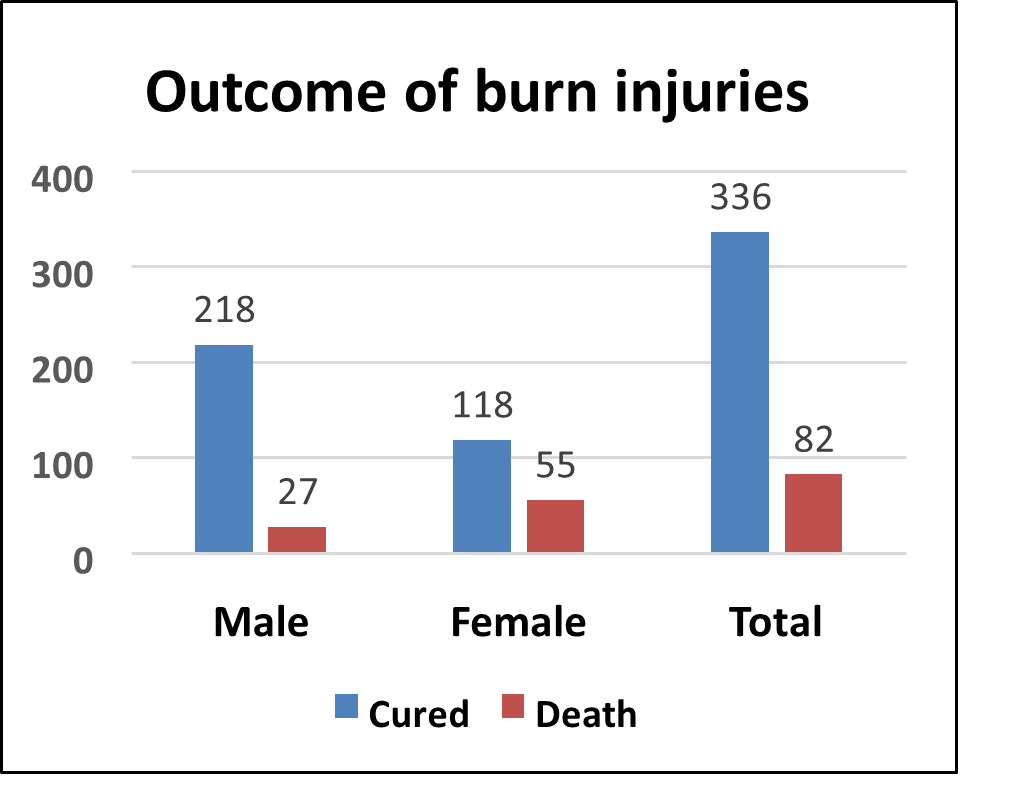
Figure 2: Frequency of outcome of burn injuries among male and female victims (n=418) The study found that majority, 32(39.0%) of deaths occurred due to septicemia followed by cases of respiratory tract issues 27(33.0%) and shock 23(28.0%).
In the present study, the data of total 418 burn victims were evaluated admitted/ presented during three-year period. Our study findings revealed the male preponderance among the burn victims. These findings are consistent with other studies by Hassan Q. et al., Naeem M. et al. and Wardhana A. et al.(2, 12, 13) This may be due to fact that males are more exposed to the industrial work and other fire causing activities like smoking.Whereas, our findings are relatively inconsistent to the studies conducted in other south Asian countries that reported female predominance.(14, 15) The females are mostly burnt due to household explosions or cooking oil burns. Main reasons are inexperience with cooking, use of risky fire appliances and use of conventional synthetic clothing that catch fire quickly as well as spread it throughout the body of victim. Sometimes the burns are inflicted upon by the partner and could be owing to intentional burning owing to family feuds.(16) Lower prevalence of females in this study may be because majority of victims were from urban setting where most of females are educated and do not frequently use liquid fuel for domestic purposes. Our study observations discovered that the most common age group in burnt victims was 1 to 10 years. This high incidence can be explained by unawareness of children, their curiosity, and lack of natural instinct to understand the hazard of certain objects as well as their exploring nature and activity. The findings consistent with our study are reported by Ahmed A. et al., George S. et al. and Ebrahem N. et al. (17-19) Scalds resulting from spillage or immersion in hot water baths, hot cooking oils and hot food and liquids account for one-half of all burns in high and middle-income countries and globally account for approximately 5% of all burn-related deaths. (18, 19) Children are more vulnerable to the effects of scalds due to their thinner skin. Present study exhibited that during the period of three years, out of 418 burn cases; 201(48.1%) had scald as the source of injury. These findings are consistent with the findings of Bangladeshi, Egyptian and Pakistani studies by George S. et al, Ebrahem N. et al and Ahmed A. et al.(17-19) While the findings of Kandeel et al, Hassan Q et al. and Bailey et al. were inconsistent to our study findings where flame was the major cause of burn in their studies.(2, 5, 20) Furthermore, our study findings are in agreement with Bailey et al., George S. et al and Ebrahem N et al where scald was the the most common cause of burn among infants, while flame was the most common of cause of burn injuries among adult and elderly. This may be due to the fact that infants display careless behavior and adults in addition to their occupational exposure to burn injuries, make use of domestic gas stoves.(5, 18, 19) The current study also revealed that over two third (79.4%) of burns occurred at home. This could be attributed to the fact that the vast majority of burnt victims in the present study were children who spent the majority of their days at home and were at high risk of burn injury. Moreover, majority of adult females in our setting are housewives that spend maximum time in front of stoves for cooking purpose where hot foods, liquids, and hot cooking oils spillage result in domestic burn cases. These findings are consistent with studies by George S. et al, Ebrahem N et al. and Ali et al.(18, 19, 21) In the present study based on manner of injury, 72.2% of cases were accidentally injured with burn. While suicide cases account for 16.5% of total cases. This is probably due to the fact that suicide burns are uncommon method for suicide in Pakistan, as evidenced by the low number of suicidal cases compared to accidental instances. Moreover, this goes against religious principles, as suicide is considered a criminal act against oneself under Islamic law.(22) It could also be attributed to an underestimating of suicidal burn, as incident reporters may not record the exact method of burn for fear of legal responsibility. The same findings were observed Kandeel et al. and Hashish et al.(20, 23) Burnt area percentage or degree depends upon situation created when the incident occurred. In an oil spill or an industrial burn, the burns are usually gross bodily burns involving mostly a large part of the body and sometimes permanent damage ensues in a vital organ that may take the life of a person. However, we did not study the postmortem cases but the medico-legal cases of burns on the account to chart out the demographics of different parameters. According to our study the percentage area burnt is classified into 5 broad ranges among which the most frequent range group is under 20%. This finding is in agreement with Ahmed A et al.(17) The biggest limitation of this study was that the data was collected retrospectively and information given in the records had to be relied on.
Infants, toddlers and children (≤ 10 years) are the most vulnerable individuals with burns. Males are more affected by burns than their counterpart. Wet scalds are the most common type of burns, while majority of victims get cured. Majority of cases are accidentally affected with burn and the most common cause of death is septicemia.
We would like to acknowledge the support of the staff members of the Burn unit of Liaquat University of Medical and Health sciences, Hyderabad.
- Jeschke MG, van Baar ME, Choudhry MA, Chung KK, Gibran NS, Logsetty S. Burn injury. Nature Reviews Disease Primers. 2020;6(1):1-25. doi: 10.1038/s41572-020-0145-5 Hassan Q, Ali MI, Mirza F. Burns: Epidemiology and Distribution Pattern in Karachi–A One-Year Survey. Pakistan Journal of Medicine and Dentistry.
- James SL, Lucchesi LR, Bisignano C, Castle CD, Dingels ZV, Fox JT, et al. Epidemiology of injuries from fire, heat and hot substances: global, regional and national morbidity and mortality estimates from the Global Burden of Disease 2017 study. Injury prevention. 2020;26(Suppl 2):i36-i45. doi: 10.1136/injuryprev-2019-043299
- Zia N, Latif A, Mashreky SR, Al-Ibran E, Hashmi M, Rahman A, et al. Applying quality improvement methods to neglected conditions: development of the South Asia Burn Registry (SABR). BMC research notes. 2019;12(1):1-6. doi:10.1186/s13104-019- 4063-0
- Lerman SF, Sylvester S, Hultman CS, Caffrey JA. Suicidality after burn injuries: A systematic review. Journal of Burn Care & Research. 2021;42(3):357-64. doi: 10.1093/jbcr/irab014
- Kevin M, Sullivan A. OpenEpi-Toolkit Shell for Developing New Applications.[Online] 2019 [Cited 2019 October 05].
- Siddiqui E, Zia N, Feroze A, Awan S, Ali AL, Razzak JA, et al. Burn injury characteristics: findings from Pakistan national emergency department surveillance study. BMC emergency medicine. 2015;15(2):1-7. doi:10.1186/1471-227X-15-S2-S5
- Bansude M, Kadavkar S, Umbare R, Dode C. A prospective study of medicolegal autopsies to establish profile of burn deaths. IP International Journal of Forensic Medicine and Toxicological Sciences. 2021;6(3):95-101.
- AHMED A, KHAN AA, ARIF S, TAHIR H, MALIK AR. ANALYSIS OF 300 MEDICO LEGAL CASES OF BURN IN LAHORE IN 2018 A RETROSPECTIVE STUDY. Pakistan Postgraduate Medical Journal. 2018;29(2):45-51.
- Ebrahem N, Shaltout E, Ali WM. Study of Medicolegal Aspects of Burnt Cases Admitted to Burn Unit, Assiut university Hospitals: retrospective study. Zagazig Journal of Forensic Medicine. 2022;20(1):82-98. doi: 10.21608/ZJFM.2021.86904.1085
- Shekhani SS, Perveen S, Hashmi D-e-S, Akbar K, Bachani S, Khan MM. Suicide and deliberate selfharm in Pakistan: a scoping review. BMC psychiatry. 2018;18(1):1-15. doi:10.1186/s12888-017-1586-6
- Hashish RK, Abdel-Karim RI. A Study of Burn Injuries in Patients Admitted to the Burn Unit, Suez Canal University Hospital: Medico-Legal Perspectives. Mansoura Journal of Forensic Medicine and Clinical Toxicology. 2017;25(1):79-91. doi:10.21608/MJFMCT.2018.47272

An Official Publication of
Islamabad Medical & Dental College
Volume 12 Issue 1
Address of Correspondence
Amna Mangi
Email:
amna.mangi1985@gmail.com
Cite this article.Ram H, Memon J UQ, Mangi A, Talpur M G A, Qadri N A, Qazi S A F Medicolegal Aspect Analysis of Burn Cases In Liaquat University Hospital, Hyderabad.J Islamabad Med Dental Coll. 2023; 12(1): 42-48