Predictors of Relapse and Survival in Testicular Germ cell Tumors in Children
Sajid Ali1 ,Tariq Latif 2 ,Muhammad Ali Sheikh 3,Shazia Perveen 4,Muhammad Bilal Shafiq5,Muhammad Abubakar 6
1Fellow, Pediatric Surgery, Shaukat Khanum Memorial Cancer Hospital and Research Centre, Pakistan
2Consultant, Pediatric Surgery, Shaukat Khanum Memorial Cancer Hospital and Research Centre, Pakistan
3Locum Consultant, Pediatric Surgery, Shaukat Khanum Memorial Cancer Hospital and Research Centre, Pakistan
4Senior Rgistrar, Pediatric Surgery, Liaquat University of Medical and Health Sciences, Pakistan
5Fellow, Orthopedic Surgery, Shaukat Khanum Memorial Cancer Hospital and Research Centre, Pakistan
6Biostatistician, Cancer Registry, Shaukat Khanum Memorial Cancer Hospital and Research Centre, Pakistan
Background:Testicular germ cell tumors are common solid organ malignancies in children with a survival rate of more than 90 %. This study aims to assess the predictors of relapse and survival in testicular germ cell tumors in children.
Methodology:A retrospective review was conducted on children up to the age of 18-years from January 2010 to December 2020 with a diagnosis of primary testicular germ cell tumors. Factors related to relapse and survival like age, baseline levels of tumor markers in serum and on relapse, stage at diagnosis, histological type, tumor laterality & size of the tumor in testicular germ cell tumors were analyzed. The data was entered into SPSS version 20. Statistical significance was set at a p-value ≤0.05
Results: A total of 115 patients with a mean age of 5.42+ 1.54 years having testicular germ cell tumor were treated. Seventeen patients (14.7 %) had relapse of disease. Relapse was highest in patients with stage I disease (64.7 %). Yolk sac tumor was the most common pathology that was noted in twelve (70 %) patients. The most common site of relapse was the retroperitoneum (70 %). Age of patient, stage of disease, and lymphovascular invasion were significant predictors of relapse and survival in testicular germ cell tumors.
Conclusion: Management of patients with testicular germ cell tumors requires standardized follow-up protocol for early detection and treatment of disease relapse. Complete surgical excision with meticulous control of the residual disease is critical to prevent disease relapse.
Key words:Chemotherapy, Children, Outcome, Relapse, Testicular Tumor
Testicular cancer is one of the common tumors in over the past few decades.2 These tumors are highly young males worldwide.1 Testicular germ cell curable with modern treatment modalities of surgery and adjuvant therapy with a survival rate of more than 90 % .3 However, disease relapse related to testicular germ cell tumor (GCT) is a well-known entity, which is seen during the first two years of initial diagnosis, requiring further treatment and is associated with long-term risk of second malignancy and cardiovascular disease .4
Serum tumor markers like Alpha-fetoprotein (AFP), human chorionic gonadotropin (HCG), and ultrasound of the scrotum and abdomen are important tools in the surveillance of testicular tumors.5, 6 However, there is no clear consensus on how to follow these patients after their initial management to identify relapse reliably without causing further harm.7 Standardized follow-up protocol and risk stratification are crucial to clarify the guidance for optimal surveillance of low-risk groups and adjuvant treatment for a high-risk group that results in optimizing the risk-benefit ratios for individuals and avoiding the potential consequences of disease relapse treatment-related morbidity.8 There is limited data in pediatric literature discussing factors responsible for relapse and survival in testicular GCTs. Although few studies in the adult population have discussed factors that predict the survival outcome in testicular germ cell tumors but they are mostly assessing stage I disease.9 O’Shaughnessy proposed the late relapse after two years in germ cell tumors (GCT) in the absence of a second primary tumor and determined predictors of survival outcome while another study by Kvammen et al, focused on Long-term relative survival (RS) for testicular germ cell tumor (TGCT) patients classified by age, histology and time at diagnosis .10,11 On the other hand, Wagner et al described the correlation of the prognostic factors with outcome in children with Stage I malignant testicular germ cell tumors.12Therefore, the stratification of variables regarding prediction of relapse and their impact on survival outcome is important.
In the literature, there are a few studies worldwide on factors influencing outcomes in Testicular Germ Cell tumors and data related to factors associated with relapse in the Paediatric population is extremely lacking, especially from developing countries like Pakistan. Therefore, this study was designed to assess the factors like age, levels of tumor markers in serum, stage at diagnosis, histological type, tumor laterality & size of the tumor as predictors of relapse and survival in testicular germ cell tumors in children.
This is a retrospective study conducted at the Department of Surgical Oncology at Shaukat Khanum Memorial Cancer Hospital & Research Centre, Lahore from January 2010 to December 2020 after Institutional Review Board (IRB) approval. We included all male patients up to the age of 18 years (according to institutional policy) with primary testicular germ cell tumors.
Data was retrieved with a keyword search of "testicular germ cell tumor or malignancy", in our electronic health records. Variables that were assessed included following characteristics at initial diagnosis and at relapse: Age, levels of tumor markers, stage of disease, histological type, tumor laterality & size of the tumor. All findings were recorded into a pre-designed form.
On initial presentation, Testicular GCT was staged according to Children's Oncology Group (COG).13Upfront high inguinal radical orchiectomy performed in all the patients and further treatment devised according to the stage after discussion in the weekly multidisciplinary tumor board. Cisplatinbased adjuvant chemotherapy (First Line
Chemotherapy) was given based on the high stage of the tumor, raised tumor markers, and the presence of metastatic or residual disease. Completion of treatment was documented at the end of treatment scans and regular follow up was maintained with measurement of three-monthly tumor markers (serum AFP & b HCG levels), an x-ray of chest and ultrasound of abdomen and scrotum for two years then six-monthly up to 5 years.
In case of disease relapse during follow-up (diagnosed on basis of clinical assessment, tumor markers & follow-up scans) patients were restaged and chemotherapy for relapse (second line chemotherapy) was instituted. The decision to resect metastatic or residual disease after chemotherapy was individualized after discussion in the multi-specialty board. Metastatectomy and Retroperitoneal Lymph Node Dissection (RPLND) were usually performed post-chemotherapy in patients with resectable residual disease and a rising pattern of serum tumor markers (AFP/ b HCG). SPSS v.20 statistical software was used for data analysis. Mean and standard deviations were used to describe quantitative data while frequencies and proportions were used to describe categorical data. Survival analysis was done in terms of overall survival (OS) and disease-free survival (DFS). Disease-free survival (DFS) was defined from the date of completion of treatment to the date of the disease relapse, progression, or death, and overall survival (OS) was the time from the initial diagnosis to the date of last follow-up or death due to any cause. DFS and OS were analyzed by the KaplanMeier method. Chi square test was used to consider factor associated with relapse with P values <0.05 were considered significant. Data was further stratified according to Stage (early stage I & II vs late stage III & IV), Age (< 12 years vs > 12 years), Time of Relapse (within 6 month & more than 6 months) and Vascular invasion (Yes or No) for evaluating the factors associated with relapse, DFS & OS.
One hundred and fifteen patients with primary testicular tumors were managed during the mentioned period of 11 years with the mean age at initial diagnosis being 5.42+ 1.54 years. Baseline characteristics of patients at initial diagnosis of Testicular germ cell tumors are detailed in Table 1
|
Table I: Baseline Characteristics of Patients with Pediatric Testicular Tumors |
||
|
Characteristics |
Number (%) |
|
|
Duration of symptoms |
|
|
|
< 1 month 1- 3 months 4-6 months > 6 months |
04 (3.5%) 43 (37.4%) 36 (31.3%) 32 (27.8%) |
|
|
Age |
||
|
0.5 - 12 years 12 - 18 years |
85 (73.9%) 30 (26.1%) |
|
|
Clinical Presentation |
||
|
Testicular swelling Testicular swelling +Pain in swelling Testicular swelling + Distant symptoms |
81 (70.4%) 12 (10.4%) 22 (19.1%) |
|
|
Tumor Laterality |
||
|
Right testis Left testis Bilateral |
62(54 %) 52 (45 %) 01 (0.9 %) |
|
|
Histological Type |
||
|
Yolk-sac Tumor Mature Teratoma Immature Teratoma Mixed germ cell tumor Embryonal carcinoma Seminoma Sex cord-stromal tumors Choriocarcinoma |
72 (62.6 %) 03 (2.6 %) 01 (0.9 %) 26 (22.6 %) 04 (3.5 %) 06 (5.2 %) 02 (1.7 %) 01 (0.9 %) |
|
|
Stage at diagnosis |
||
|
Stage I Stage II Stage III Stage IV |
53 (46.1 %) 11 (9.6 %) 17 (14.8 %) 34 (29.6 %) |
|
|
Site of metastasis (n=51) |
||
|
Lung Lung + Retroperitoneum Lung + Inguinal lymph nodes Retroperitoneum Retro peritoneum + Inguinal lymph node Liver Inguinal Lymph node |
07 (6 .8%) 21 (18.2 %) 01 (0.9 %) 17 (14.7%) 01 (0.9 %) 01 (0.9 %) 03 (2.6 %) |
|
In our study all patients had undergone upfront high inguinal radical orchiectomy followed by 14 patients of relapse had lympho-vascular invasion on primary histopathology making it a significant factor in predicting relapse (p<0.05). A summary of the factors associated with relapsed testicular germ cell tumor is outlined in Table 2.
|
Table 2: Characteristics of Patients with Relapsed Testicular GCT |
|
|
Characteristics |
Number (%) |
|
Age at relapse (years) |
|
|
0.5-12 years > 12 years |
16 (94 %) 01 (6 %) |
|
Time to relapse (months) |
|
|
Mean |
6.87 + 1.12 |
|
Tumor markers (AFP) |
|
|
Baseline On Relapse |
(9933.06) (3836.41) |
|
Tumor Laterality |
|
|
Right testis Left testis |
11 (64 %) 06 (36 %) |
|
Histological Type |
|
|
Yolk-sac Tumor Mixed germ cell tumor Embryonal carcinoma Seminoma |
12 (70.5 %) 03 (17.6 %) 01 (5.8 %) 01 (5.8 %) |
|
Stage |
|
|
Stage I Stage II Stage III Stage IV |
11 (64.7 %) 02 (11.7 %) 02 (11.7 %) 02 (11.7 %) |
|
Site of relapse |
|
|
Retroperitoneum 06 (18.3 %) Lung + Retroperitoneum 04 (0.9 %) Inguinal lymph nodes 01 (18.3 %) Multiple organ site 02 (0.9 %) |
|
|
Lympho vascular invasion on histology |
|
|
Yes No |
14 (82.3 %) 03 (17.6 %) |
adjuvant chemotherapy (First Line Chemotherapy) and three patients already underwent metastatectomy (RPLND) following the First line adjuvant chemotherapy according to the protocol. Seventeen (14.7 %) patients developed relapse after complete remission. The mean age of patients at relapse was 8.526 + 2.72 years and the median age was 3.2 (IQR 1-13). Patients in less than 12 years of age group relapsed more as compared to older age groups. (p<0.05).
The mean time to relapse of disease was 6.87+ 1.12 months after completion of treatment. Out of seventeen patients with relapse, eleven (64 %) presented within three months, and six (36 %) patients presented after six months of treatment. Among these patients with relapse, eleven (64 %) had a right-sided tumor and 06 (36 %) had tumor on the left side. Tumor marker (AFP) was significantly raised in all patients but not statistically significant as compared to baseline.
Relapse was highest in patients with stage I disease (11 patients) followed by two patients in each stage II, III and IV. No statistical significance was found between stage & relapse. The most common site of
relapse was retro peritoneum. Yolk sac tumor was the most common pathology that was noted in twelve (70 %) patients, three (17 %) patients had mixed germ cell tumor, one had seminoma and another one had embryonal carcinoma. No correlation was found between histological sub type and relapse (p>0.05)
The seventeen patients who relapsed were restaged; 06 patients had stage III while 11 patients had stage IV disease at relapse. All of them received second line chemotherapy VIP (etoposide or vinblastine plus ifosfamide and cisplatin) as per protocol. Post-Chemotherapy reassessment showed residual disease in six (30 %) patients who underwent surgery; One had retroperitoneal lymph node dissection (RPLND), 03 underwent inguinal lymph node excision, one had excision of the residual scrotal mass while one patient underwent Video-assisted Thoracoscopy (VATS) & wedge excision of lung nodules.
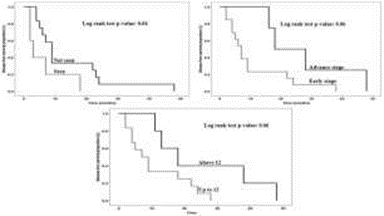
Figure: 1: Graphical representations of disease-free survival. A: Stratification of data according to lymphovascular invasion. B: stratification of stage. C: stratification of age for disease free survival. Regarding treatment outcome, 14 patients (82.3%) had complete remission while 03 patients (17.6%) had a second relapse. Of these 3 patients, one received further chemotherapy (Third Line Chemotherapy) that was 4 cycles of Gamitabine/Oxaliplatin and had remission, second patient is currently on palliative chemotherapy while the third patient expired due to rapidly progressive disease while on chemotherapy. The median duration of follow-up of the patients after relapse was 56 months. The median diseasefree survival in the vascular invasion group was 3 months while median DFS in the no vascular invasion group was 9 months with statistically significant disease-free survival (p-value 0.04) in patients with no vascular invasion (Figure 1a). The median DFS in the early and advanced stage was 7 and 18 months, respectively (Figure 1b). Age groups (up to 12 years and above 12 years) also showed significance (0.04) and the median DFS time in both the age groups were 7 and 18 months respectively as shown in Figure 1c.
Testicular germ cell tumors are common in children and adolescent age groups and treatment with modern platinum-based chemotherapy and surgery has revolutionized the overall outcome with a high cure rate.14, 15 Besides delayed presentation, advanced disease stage, inappropriate treatment of the residual disease are the predictors of overall poor outcome. Disease relapse related to testicular germ cell tumor (GCT) is another major factor that leads to poor outcomes, therefore accurate risk prediction of relapse is essential to avoid the serious potential consequences of overtreatment. Risk factors should be analyzed to predict relapse and survival in testicular germ cell tumors in children to make uniform guidelines for treating physicians. In our cohort of 115 patients who were treated for testicular GCTs, seventeen (14%) patients had a relapse. The mean age at relapse was 8.526 + 2.72 years. The mean time to relapse after treatment completion was 6.87+ 1.12 months which is supported by findings of Thomas et al and others who reported that recurrence rate after 24 months is less in patients with testicular germ cell tumors.16 The analysis of age groups (up to 12 years and > 12 years) showed significant difference (p-value 0.05) in the median disease-free survival (DFS) time in both the age groups that was 07 and 18 months respectively, which suggests the importance of regular follow-up for early detection and treatment. Depani S et al 17 reported high recurrence rate in patients with testicular germ cell tumors of Stage IIIV disease in contrast to findings
in our study where patients with Stage I disease were found to have more relapse probably due to higher number of patients in this age group and later presented with advanced stages of disease (stage III & IV). The retroperitoneum was the most common site of relapse (58 %) with the majority having bulky retroperitoneal nodal size >10 cm, similar findings have been reported in the literature. 18, 19 Furthermore, retroperitoneal relapse was seen even in the patients who had a prior history of retroperitoneal lymph node dissection (RPLND) in our study, comparable with results documented by Moore et al 19, further emphasizing the critical role of RPLND by an experienced surgeon in the management of testicular GCT.
The patients who received adjuvant first line chemotherapy also had a significant disease relapse as compared to chemotherapy-naive patients, which are comparable with the findings addressed by Friedlander et al, emphasizing that chemotherapy before relapse was a statistically significant and clinically relevant predictor of inferior outcome due to difference in the biology of chemotherapy-naive patients at late relapse from that of patients with a prior history of chemotherapy.20 The findings from another study suggest that in patients with metastatic non-seminomatous germ cell tumors after chemotherapy there was still a small, but continuing risk of recurrence even after 05 years.21 On the other hand, Lu SY et al reported in their study that children who were treated with adjuvant chemotherapy had an excellent outcome with a 3year OS of >90% in relapsed and metastatic
disease.22
The level of serum tumor markers like Alphafetoprotein (AFP) is useful in diagnosing and monitoring testicular tumors. Various studies have documented that patient with raised AFP at baseline have a poor prognosis, which is also in consistence with our findings.23 keeping with the present study, serum AFP levels were significantly elevated on presentation as well as on relapse in all the patients. Regarding tumor laterality, the right side of the tumor had more relapse in eleven (64 %) patients and Non-seminomatous GCT (Yolk Sac Tumor) was the most common pathology found in patients who relapsed which is comparable with the findings documented in the literature.22
On analyzing the patients with lymphovascular invasion at presentation, fourteen patients had lymph vascular invasion who later presented with disease relapse with statistically significant diseasefree survival (p-value 0.04) and median disease-free survival was (03 vs 09 months in both groups). Lobo J et al documented that patients with vascular invasion have worse relapse-free survival compared to those without vascular invasion with p < 0.001. Therefore, the presence of lymph vascular invasion is an important risk factor for predicting the disease relapse on histopathology 25.Limitation of this study is that it was a single centered and retrospective study with a small number of patients.
Management of patients with Testicular GCTs requires multidisciplinary team approach and standardized follow-up protocol for early detection and treatment of relapse. Complete surgical excision with meticulous control of the residual disease is critical to prevent disease relapse. The standardization of follow-up for individual patients can result in optimizing risk/benefit ratios.
- Pietrzyk Ł, Denisow-Pietrzyk M, Czeczelewski M, Ślizień-Kuczapski K, Torres K: Cancer education matters: a report on testicular cancer knowledge, awareness, and self-examination practice among young Polish men. Scientific Reports. 2020, 26:1-9. 10.1038/s41598-020-77734-3
- Park JS, Kim J, Elghiaty A, Ham WS: Recent global trends in testicular cancer incidence and mortality. Medicine. 2018, 97:10.1097/MD.0000000000012390
- Cheng L, Albers P, Berney DM, Feldman DR, Daugaard G, Gilligan T, et al. Testicular cancer. Nature Reviews Disease Primers. 2018 Oct 5;4(1):29. Kozakova K, Mego M, Cheng L, Chovanec M. Promising novel therapies for relapsed and refractory testicular germ cell tumors. Expert Review of Anticancer Therapy. 2021 Jan 2;21(1):53-69.
- Thomas KL, Jeong D, Montilla-Soler J, Feuerlein S: The role of diagnostic imaging in the primary testicular cancer: initial staging, response assessment, and surveillance. Translational andrology and urology. 2020:9. 10.21037/tau.2019.07.01
- Nicholson BD, Jones NR, Protheroe A, Joseph J, Roberts NW, Van den Bruel A, et al. The diagnostic performance of current tumour markers in surveillance for recurrent testicular cancer: A diagnostic test accuracy systematic review. Cancer Epidemiology. 2019 Apr 1;59:15-21. Honecker F, Aparicio J, Berney D, Beyer J, Bokemeyer C, Cathomas R, et al. ESMO Consensus Conference on testicular germ cell cancer: diagnosis, treatment and follow-up. Annals of oncology. 2018 Aug 1;29(8):1658-86.
- O’Shaughnessy MJ, Feldman DR, Carver BS, Sheinfeld J. Late relapse of testicular germ cell tumors. Urologic Clinics. 2015 Aug 1;42(3):359-68. Kvammen Ø, Myklebust TÅ, Solberg A, Møller B, Klepp OH, Fosså SD, et al . Long-term Relative Survival after Diagnosis of Testicular Germ Cell TumorRelative Survival after Testicular Germ Cell Tumor. Cancer Epidemiology, Biomarkers & Prevention. 2016 May 1;25(5):773-9.
- Khazaei Z, Sohrabivafa M, Mansori K, Naemi H, Goodarzi E: Incidence and mortality of cervix cancer and their relationship with the human development index in 185 countries in the world: An ecology study in 2018. Advances in Human Biology. 2019, 1:222. 10.4103/AIHB.AIHB_15_19
- Thomas LJ, Brooks MA, Stephenson AJ. The role of imaging in the diagnosis, staging, response to treatment, and surveillance of patients with germ cell tumors of the testis. Urologic Clinics. 2019 Aug 1;46(3):315-31.
- Friedlander TW, Small E. Testicular cancer. InAbeloff's Clinical Oncology 2020 Jan 1 (pp. 14421467). Elsevier.
- Lu SY, Sun XF, Zhen ZJ, Qin ZK, Liu ZW, Zhu J, et al . Survival analysis of children with stage II testicular malignant germ cell tumors treated with surgery or surgery combined with adjuvant chemotherapy. Chinese journal of cancer. 2015 Feb;34(2):86-93.
- Lobo J, Gillis AJ, van den Berg A, Looijenga LH: Prediction of relapse in stage I testicular germ cell tumor patients on surveillance: investigation of biomarkers. BMC cancer. 2020, 20:1-6. 10.1186/s12885-020-07220-6

An Official Publication of
Islamabad Medical & Dental College
Volume 12 Issue 1
Address of Correspondence
Sajid Ali
Email:
drsajidali@yahoo.com
Cite this article.Ali s, Latif T, Sheikh M A, Perveen S, Shafiq M B, Abubakar M. Predictors of Relapse and Survival in Testicular Germ cell Tumors in Children.J Islamabad Med Dental Coll. 2023; 12(1):29-35 DOI: https://doi.org/10.35787/jimdc.v12i1.896