How common is Hypoglycemia in Newborns Weighing less than 2500gms - A Hospital Based Study
Malak Ahmad Khan1, Sohail Shahzad1, Ameena Saba Awan2, Wajeeha Amber2, Syed Taqi Hassan1
1Department of Paediatrics, Combined Military Hospital, Abbottabad; 2 Department of Paediatrics, Karachi Institute of Medical science/NUMS Malir Cantt, Karachi
Objective: To determine the frequency of hypoglycemia in neonates weighing less than 2500 grams in first 48 hours of life presented to CMH, Abbottabad.
Methodology: A total of 110 neonates of both genders with birth weight less than 2500 grams using consecutive non-probability sampling technique were included in the study. Capillary blood was collected by heel prick after proper aseptic measure for blood glucose estimation by Glucometer at 0, 1, 2, 3, 6 and every 6 hours till 48 hours of birth. All hypoglycemic neonates were managed with intravenous administration of 10%glucose.
Results: Gestational age range in this study was from 34 to 42 weeks with mean gestational age of 38.663±1.55 weeks, mean birth weight 1622.818±409.23 grams and mean blood glucose level was 54.763±9.55 mg/dl. Total 80% neonates were male. Hypoglycemia was observed in 27.3% neonates. No significant difference was seen comparing frequency of hypoglycemia among pre-term and term neonates (p-value 0.52), male vs female neonates (p-value 1.00) and different modes of delivery. (p-value 0.6). While frequency of hypoglycemia was significantly high in extremely low birth neonates as compared to low and very low birth weight. (p-value <0.01).
Conclusion: Our study concluded that frequency of hypoglycemia was 27.3% in newborns weighing less than 2500 grams in first 48 hours of life. Extremely low birth weight (less than 1000gms) is a significant determinant for hypoglycemia.
Keywords: First 48 hours, frequency, low birth weight, hypoglycemia, new born.
Statins Hypoglycaemia is one of the commonest metabolic complications in new born and is associated with long term adverse neurological outcome because of the increased sensitivity of neurons and glial cells to low glucose levels.1,2 Hypoglycemia can occur without any symptom however jitteriness, irritability, tremors seizures, coma, lethargy, apathy, limpness, poor feeding, vomiting, apnea, weak or high-pitched cry and cyanosis can be present in some patients. Even in neonates without any symptoms unobserved prolong hypoglycemia may cause nervous system injury.3 So early detection and prompt timely treatment is necessitated.4
In addition to various neonatal illnesses, otherwise healthy neonates having birth weight less than 2500 grams have increased risk of developing hypoglycemia.5,6,7 In the first 2 to 4 postnatal hours hypoglycaemia does occur in almost all neonates due to cessation of placental circulation and resultant maternal nutrition. Normally in neonates normoglycemia is maintained if the glycogen stores, maturation of glycogenolytic and gluconeogenic pathways and an integrated endocrine response is adequate. In healthy neonates born at term usually these adaptive mechanisms are well established so hypoglycaemia resolves itself without causing any pathological consequences. In premature and low birth weight babies these metabolic and endocrine mechanisms are less well developed so they tend to develop prolong hypoglycaemia and related complications.8 Various studies have been conducted in the past worldwide to find out the frequency of hypoglycaemia in low-birth-weight babies and their results showed different frequencies ranging from 24-55%.
Nevertheless, even minimum frequency is quite significant and if left untreated can cause devastating effects and permanent handicap. Considering the magnitude of the problem we planned to conduct similar study in our population. It will not only quantify the burden of the disease in our population but will also help us to device proper strategies for the prevention and treatment of the disease. Study objective was to determine the frequency of hypoglycemia in neonates with birth weight less than 2.5kg in first 48 hours of life presented to CMH Abbottabad.
This cross-sectional study was conducted at the Department of Pediatrics, Combined Military Hospital, Abbottabad, from 1st July 2020 to 1st January 2021. The calculated sample size was 110 with 24% frequency of hypoglycemia in neonates with low birth weight,9 confidence interval being 95% and margin of error 5% using WHO sample size calculator. Consecutive nonprobability sampling method was used for case enrolment. Hypoglycemia was defined as random blood sugar less than 45mg/dl. All neonates born at gestational age 34-42 wks and weighing less than 2.5kg irrespective of mode of delivery was enrolled. Neonates of diabetic mothers, sick neonates and those with history of neonatal sepsis, ARDS, birth asphyxia, congenital anomalies and endocrine disorders were excluded from study. Ethical approval from Institutional Ethical Review Committee. (ERC#) was taken before conducting this study. A detailed antenatal, natal and postnatal history of enrolled neonates was obtained and careful examination was done. Gender, gestational age, mode of delivery, birth weight (determined with an electronic weighing machine). Apgar score, resuscitation requirement and immediate postnatal events were recorded. Blood sample was taken using heel prick method after proper aseptic measures to collect capillary blood and Glucometer was used for glucose estimation at 0, 1, 2, 3, 6 and every 6 hours till 48 hours of birth. All hypoglycemic neonates were managed with intravenous administration of 10% dextrose water. Data was recorded in a pre-designed proforma. SPSS version 21 was used foe data analysis. Descriptive statistics like frequency, percentage, mean and standard deviation were calculated. Hypoglycemia was stratified by gestational age, gender, category of birth weight (Extremely Low, Very Low & Low) & mode of delivery. Post-stratification Chi-square test was applied. P value of ≤ 0.05 was taken as significant.
Gestational age range in this study was from 34 to 42 weeks with mean gestational age of 38.663+ 1.55 weeks, mean birth weight 1622.818 + 409.23 grams and mean blood glucose level was 54.763+ 9.55 mg/dl. Male patients were 88 (80%) and females were 22 (20%). Frequency and percentage of patients according to different birth weight category and different modes of delivery has been shown in figure I and table 1 respectively. Hypoglycemia was
observed in 30 (27.3%) neonates. No significant difference was seen comparing frequency of hypoglycemia among pre-term and term neonates (p-value 0.52), male vs female neonates (p-value 1.00) and different modes of delivery like normal vaginal delivery.
Table I: Stratification of hypoglycemia according to gestational age, gender, birth weight and mode of delivery (n=110) |
|||
|
Hypoglycemia |
P-value |
|
yes |
No |
||
Gestational age |
24(26.1%) |
68(73.9%) |
0.528 |
Gender |
24(27.3%) |
64(72.7%) |
1.000 |
Birth weight |
12(80%) |
3(20%) |
<0.01 |
Mode of delivery |
8 (29.6%) |
19(70.4%) |
0.623 |
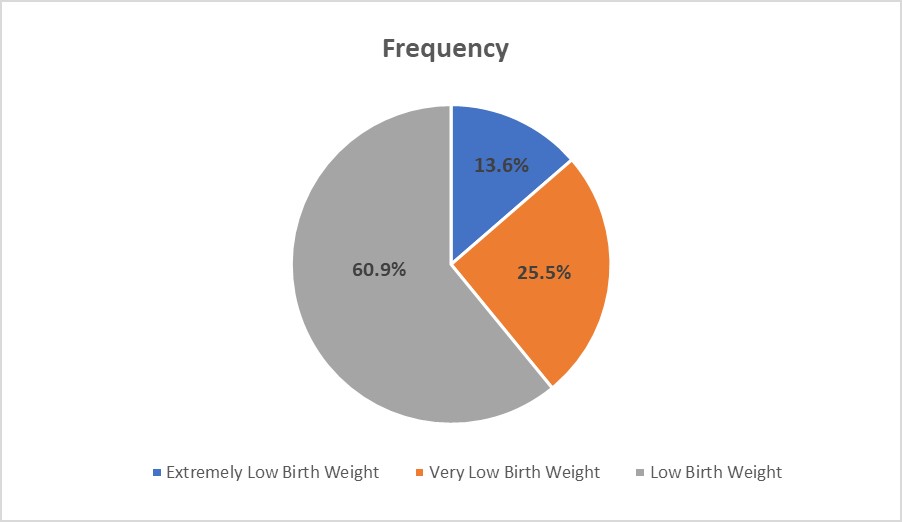
Figure 1: Frequency and %age of patients according to category of birth weight
The results of our study were quite significant and comparable with other studies. Total 27.3% of all low birth weight included in our study had at least one episode of hypoglycaemia in the first 48 hrs of life. Despite using recently updated growth curves to identify high risk infants surprisingly high incidence was noted. In neonatal population hypoglycaemia is the most commonly identified metabolic problem. Significant mortality and morbidity have been observed in undetected cases. Both symptomatic
and asymptomatic cases of hypoglycaemia can develop adverse long term neurological consequences.
Varying incidences have been noticed in previously conducted studies. Dias and Gada reported the incidence of hypoglycaemia (Blood glucose <40mg/dl) to be 17% in their study whereas Jonas and his colleagues reported 11.7% incidence of hypoglycemia in neonates overall.10,11
Yoon et al., reported 20% incidence in which hypoglycemia was defined as blood glucose level of less than 40mg/dl up to 24 hours and less than 50mg/dl thereafter.12
Relation of birth weight with risk of hypoglycaemia has been assessed in many studies conducted previously. In an international study by Amarendra and his colleagues, the incidence of hypoglycaemia was found 27.27% in neonates with 1500-1799gm birth weight category, 24.5% in the 1800-2199gm category and 21.21% in the 2200-2499gmcategory.In this same study the maximum frequency (72.22%) was observed in newborns falling in birthweight range of 1800-2199gm category which showed an inverse relation between birth weight and incidence of hypoglycaemia.13 Our study depicted similar results with maximum percentage of hypoglycaemia (80%) was seen in extremely low birth weight, 60.7% were very low birth weight, significant association was found. (p value <0.01) showing extremely low birth weight neonates more vulnerable to develop hypoglycemia. Similarly, Hawdon JM et al stated the most common risk factor for hypoglycaemia was low birth weight or borderline low birth weight.14 Our study did not find significant relation of gender with risk of neonatal hypoglycaemia. Same finding was noticed by Mitchell and his colleagues who conducted study in Canada with much bigger sample size.15 While significant male predisposition for developing hypoglycemia was found in studies conducted by Simchen and Jonas and their colleagues.16,17 Our study could not find significant relation of gestational age with hypoglycemia. Contradictory to this analysis studies from France and Israel conducted in 2020 and 2017 respectively found significant association of neonatal hypoglycaemia with early gestational age. 18,19 Possible explanations for this could be difference of study population. Our study population was conducted on a cohort of neonates weighing <2500gms, while their studies included neonates irrespective of their birth weights. Association of low birth weight with risk of hypoglycemia is probably much stronger than the effect of gestational age alone. Similarly, mode of delivery in our study was not proved as a a significant risk factor for developing hypoglycemia. Similar result was obtained in a study conducted in neighboring country India with a bigger sample size.20
Our study highlighted the significance of checking blood glucose level in low, very low and extremely low birth weight to prevent hypoglycemia related adverse consequences. However, like all studies our study had also few limitations. The sample size was relatively small to generalize the inferences to larger audiences. More studies with bigger sample sizes are required in future to formulate recommendations in general practice. Moreover, a number of other risk factors are needed to be evaluated like maternal age, maternal risk factors, large for gestational age babies, effects of maternal drugs, among others.
Our study concluded that frequency of hypoglycaemia in neonates weighing less than 2500gms is 27.3%. Extremely low birth weight (less than 1000gms) is a significant determinant for hypoglycaemia.
- Qiao, LX., Wang, J., Yan, JH. et al. Follow-up study of neurodevelopment in 2-year-old infants who had suffered from neonatal hypoglycemia. BMC Pediatr 19, 133 (2019). https://doi.org/10.1186/s12887-019-1509-4
- Wickström R, Skiöld B, Petersson G, Stephansson O, Altman M. Moderate neonatal hypoglycemia and adverse neurological development at 2-6 years of age. Eur J Epidemiol. 2018 Oct;33(10):1011-1020. https://doi.org/ 10.1007/s10654-018-0425-5.
- De Angelis LC, Brigati G, Polleri G, Malova M, Parodi A, Minghetti D, Rossi A, Massirio P, Traggiai C, Maghnie M, Ramenghi LA. Neonatal Hypoglycemia and Brain Vulnerability. Front Endocrinol (Lausanne). 2021 Mar 16;12:634305. https://doi.org/10.3389/fendo.2021.634305. PMID: 33796072; PMCID: PMC8008815.
- Shirley AS, Jerry ALT, Shiji R. Incidence and risk factors associated with hypoglycemia in the first 48 hours of life in Small for Gestational Age Neonates. Int J ContempPediatr. 2018;5(6):2300-3. http://dx.doi.org/10.18203/2349-3291.ijcp20184300
- Arun P, Tushar P. Maternal risk factors and outcome of low birth weight babies admitted to Gujarat Adani Institute of Medical Science, Bhuj, Kutch, Gujarat, India-a cross-sectional study.Int J Med OncolPeditar. 2017;3:54- 6. https://doi.org/10.18231/2455-6793.2017.0015
- Siddique AA, Sridhar NL. Study of Hypoglycemia in Neonates with Low Birth Weight. AJCPN [Internet]. 2020Apr.12 [cited 2022Nov.29];8(1):44-6. Available from: https://aijournals.com/index.php/ajcpn/article/view/1364
- Bhat R, George J, Lewis L, Purkayastha J. Blood Glucose Levels And Characteristics Of Hypoglycemia In Low Birth Weight Neonates. J Nepal Paediatr Soc. 2021;41(3):336-345. https://doi.org/10.3126/jnps.v41i3.32758
- Khairuzzaman M, Sarker NR, Sarker MMA, Matin A, Rakshit SC, Mojumder B, et al. Blood glucose level in low birth weight babies in first 48 hours of life. JCurrAdv Med Res 2018;5(1):33-8. http://dx.doi.org/10.3329/jcamr.v5i1.36544
- Saini A, Gaur BK, Singh P. Hypoglycemia in low birth weight neonates: frequency, pattern, and likely determinents. Int J Contemp Pediatr. 2018; 5(2): 526-32 http://dx.doi.org/10.18203/2349-3291.ijcp20180548
- Dias E, Gada S. Glucose levels in newborns with special reference to hypoglycemia: a study from rural india. J Clin Neonatol. 2014;3(1):35-8. http://dx.doi.org/10.4103/2249-4847.128729
- Jonas D, Dietz W, Simma B. Hypoglycemia in newborn infants at risk. Klin Pediatr. 2014;226(5):287-91. http://dx.doi.org/10.1055/s-0034-1385928
- Yoon JY, Chung HR, Choi CW, Yang SW, Kim BI. Blood glucose levels within 7 days after birth in preterm infants according to gestational age. Ann Pediatr Endocrinol Metab. 2015;20(4):213-9. https://doi.org/10.6065%2Fapem.2015.20.4.213
- Amarendra M, Sethi RK, V. Pericherl V. Incidence of hypoglycaemia within 72 hours after birth in low birth weight babies who are appropriate for gestational age. Int J Contemp Pediatr. 2018 May;5(3):944-948 http://dx.doi.org/10.18203/2349-3291.ijcp20181518
- Hawdon JM, Beer J, Sharp D. Neonatal hypoglycemia: learning from claims. Arch Dis Child Fetal Neonatal Ed. 2016:2016. http://dx.doi.org/10.1136/archdischild-2016-310936
- Mitchell NA, Grimbly C, Rosolowsky ET, O'Reilly M, Yaskina M, Cheung PY, Schmölzer GM. Incidence and Risk Factors for Hypoglycemia During Fetal-to-Neonatal Transition in Premature Infants. Front Pediatr. 2020 Feb 11;8(34). https://doi.org/ 10.3389/fped.2020.00034.
- Simchen MJ, Weisz B, Zilberberg, Morag I, Weissmann-Brenner A, Sivan E. Male disadvantage for neonatal complications of term infants, especially in small for gestational age neonates. J Matern Fetal Neonatal Med. 2014;27(8):839-43. https://doi.org/10.3109/14767058.2013.845658
- Jonas D, Dietz W, Simma B. Hypoglycemia in newborn infants at risk. Klin Pediatr. 2014;226(5):287-91. http://dx.doi.org/10.1055/s-0034-1385928
- Snyers D, Lefebvre C, Viellevoye R, Rigo V. La prématurité tardive : des nourrissons fragiles malgré les apparences [Late preterm : high risk newborns despite appearances]. Rev Med Liege. 2020 Feb;75(2):105-110. French. PMID: 32030935
- Bromiker R, Perry A, Kasirer Y, Einav S, Klinger G, Khademi FL. Early neonatal hypoglycemia: incidence of and risk factors. A cohort study using universal point of care screening. The Journal of Maternal-Fetal & Neonatal Medicine 2017:32(3);1-171 https://doi.org/10.1080/14767058.2017.1391781
- Natta VRS, Pagali D, Dandugula VP, Veera SB. Glycemic status in exclusively breast fed low birth weight babies In first 72 hours of life in a teriary care hospital . Int J Contemp Pediatr2019;6:1276-80. https://doi.org/10.18203/2349-3291.ijcp20192027

An Official Publication of
Islamabad Medical & Dental College
Volume 13 Issue 1
Address of Correspondence
Ameena Saba Awaan
Email:
sadiaahmed383@gmail.com
Authors’ Contribution: 1,2Conception; Literature research; manuscript design and drafting; 2,3 Critical analysis and manuscript review; 5Data analysis; Manuscript Editing.
Cite this article. Khan MA, Shahzad S, Awaan AS, Amber W, Hassan ST How common is Hypoglycemia in Newborns Weighing Less Than 2500gms -A Hospital Based Study. J Islamabad Med Dental Coll. 2024; 13(1): 71-75. DOI: https://doi.org/10.35787/jimdc.v13i1.899