Assessment of Inhaler Use Techniques among the Patients of Chronic Obstructive Lung Diseases at a Government Hospital of Islamabad
Maliha Batool1 ,Savida Ilyas Dar2 ,Rizwan Ahmad3,Hareema Saeed Khan4,Shabih Haider5,Aroosha Fareed6
1Department of Medicine, Federal Government Polyclinic Hospital, Islamabad, Pakistan
Objective: To study the frequency of incorrect techniques used for Metered Dose Inhalers in patients with chronic obstructive lung diseases.
Study Design: Cross-sectional, Observational Study
Place And Duration Of Study: The study was conducted for six months from Ist March 2019 to 31st August 2019, on all patients with chronic obstructive lung diseases visiting the outpatient department of Medicine in Federal Government Polyclinic (FGPC) Hospital as a part of their regular follow-up.
Methodology:All patients visiting the outdoor clinic were checked for their inhaler technique which was explained to them as a 6-step procedure. The record of using the inhaler correctly or otherwise was noted in a proforma.
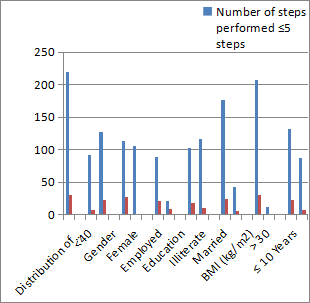
Results:A total number of 250 patients were included in the study with their ages between 13-70 years. Mean age of patients was 46.5±15.7 years. A total of 6 steps of the inhalation technique were observed. The mean number of steps followed was 3.8±1.4. Incorrect inhaler technique (≤5 steps) was adopted by 220 patients (88%) and correct technique (6 steps) was adopted by only 30 patients (12%). Stratification for age, gender, duration of disease, education, marital status, occupation, and Body Mass Index (BMI) was also carried out.
Conclusion: This study demonstrated that a significant no of patients could not perform the inhalation technique correctly. This implies the need for their clinicians to make it imperative during their follow-up visits to check their inhaler technique periodically.
Key words:Metered dose inhalers (MDI), Chronic Obstructive Lung Disease (COLD), Body Mass Index (BMI)
The mainstay in managing patients with chronic obstructive lung diseases like Asthma or COPD is the decision regarding the correct selection and use of inhalers. A single device cannot be suitable for all these patients. There has been wide use of these inhalation devices for a long period irrespective of the fact whether patients can use them properly or not and whether it is having any significant impact on their outcome or otherwise.
It is a well-known fact that diseases like Asthma and COPD have a worldwide prevalence and Metered dose inhalers (MDI) are the most common choice of treatment. Almost 33% patients from all over the world have Asthma and at the same time, 10 % of the adult population more than 40 years of age have COPD.1,2 there are 4 types of inhalation devices available in the market.
Metered dose inhalers (MDIs),
Dry powder inhalers
Breathe actuated inhalers.
Nebulizers 3.
The selection of a device depends on several factors patient age, their preference for the device, severity of their disease as well as cost and availability of the device.4,5.
Out of all possible available devices, Metered dose inhalers have become the most selected devices with clinicians because of their cost, ease of use, multiple doses and easy availability.3 Metered dose inhalers were introduced in 1950 as portable devices for bronchodilation.6 Since these devices have a local effect, they have multiple advantages like their rapidity of action, for being locally deposited in the lung. In addition, they have very few systemic effects.7 Among many other factors, the one which seems to be contributing the most towards poor control of disease and increased outdoor as well as emergency visits is poor inhaler technique.8
The NICE and the Global Initiative for Chronic Obstructive Lung Disease as well as the UK Inhaler Group (UKIG)9 have recommended that when a clinician is putting patient on any new type of inhalation device, they should teach them properly the whole technique of using the new device. It has also been recommended that management does not end with the teaching of the technique of the new device but at the same time to check this technique periodically during regular follow-up visits of the patients.10 It has been observed that out of all patients affected with this disease, almost 25% were never told the technique of using the inhaler.11Poor inhaler technique by the patient has led to several problems which include poor control of disease, increased side effects of the drug, increased visits to outpatient department and increased emergency visits. All of these factors ultimately lead to increased health care costs putting a lot of burden on the country's economy.12 As a matter of fact, despite all these factors and poor outcomes of disease, the need to educate patients about inhalation techniques is still being underestimated by clinicians.13 On account of multiple factors like the old age of the patient, poor comprehension, poor educational status and poor explanation by the clinicians, about 94% of patients do not know their inhaler technique properly and may need multiple and repeated sessions for this purpose.7Correct inhaler technique requires certain steps to be performed in proper sequence.14(Annexure attached).
Failure to exhale before inhaler use.
Failure to perform a strong inspiratory effort during inhalation.
Failure to hold breath at the end of inspiration after using inhaler.4
The basic aim of this study was to check the inhaler technique of patients with chronic obstructive lung diseases. This may help clinicians to be aware of this overlooked problem and may help to avoid a basic pitfall in the management of patients in future. This may provoke a need in future for proper education regarding inhalation techniques through repeated counselling, circulation of printed educational material, small educational videos as well as patient and clinician-oriented seminars.
At was a Cross-sectional, Observational study conducted in the Outpatient clinic of the Department of Medicine at Federal Government Polyclinic (FGPC) Hospital, Islamabad. This study was carried out over a total time duration of six months, ranging from 1st March 2019 to 31st August 2019.
The sample was calculated by the Non-probability, Consecutive Sampling Technique.
Inclusion Criteria Patients of both genders, with an age ranging between 13 to 70 years, were included in the study. The patients must have been using at least one Metered dose inhaler device for at least 3 months.
Exclusion Criteria
Patients with an inability to use the inhaler on account of having osteoarthritis, psychiatric illness, stroke, myopathy or weakness in hands due to any cause, inadequate intellect or inadequate muscle strength required for using the inhaler.
Sample size was calculated by using WHO calculator with a confidence level being 95%. Total proportion of population having improper inhaler technique was 0.94. The Absolute precision was 3%. Total Calculated sample was 250 4
Prior permission to conduct the study was taken from respective Head of Unit. Patients with chronic obstructive lung disease who visit the outpatient department of medical unit in FGPC were enrolled in the study after fulfilling the inclusion and exclusion criteria. Informed consent was taken from all the patients. They were assessed as having either a correct or incorrect technique, because whether they could perform all steps correctly or otherwise. Data were recorded on Proforma.
Data was analyzed using SPSS version 16. Quantitative variables like age, weight, BMI, duration of obstructive lung disease, total no. of steps performed were calculated asMeans ±SD. Qualitative variables like gender, education, marital status, occupation, performance of inhalational steps was recorded as percentages and frequencies. Variables like age, gender, duration of lung disease, education, marital status, occupation were controlled by stratification. Poststratification chi-square test was applied. P value of≤0.05 was recorded as significant.
Patients were in an age range of 14-70 years with meanage of patients being 46.5±15.7 years. 142 were males (56.8%) and 108 were females (43.2%). Mean BMI of the patients was 25.6±3.3 kg/m2. Mean duration of COLD was 11.8±10.0 years. Employed patients were 110 (44%) and unemployed patients were 140(56%). Literate patients were 122 (48.8%) while illiterate patients were 128 (51.2%). Majority of the patients were married 201 (80.4%). Most of the patients belonged to middle class group 119 (47.6%) followed below income and high-income groups. Study variables showing baseline demographics are mentioned in Table 1
|
TABLE 1: DEMOGRAPHIC VARIABLES OF STUDY |
||
|
VARIABLES |
NUMBER(N) |
MEAN+/- Standard deviation |
|
Number of patients |
250 |
|
|
Age (years) 14-40 41-70 |
100(40 %) 150(60 %) |
46.5±15.7 |
|
Gender Male Female |
142(56.8 %) 108(43.2 %) |
|
|
BMI (kg/m2) ≤ 30 > 30 |
237(94.8%) 13(5.2%) |
25.6±3.3 |
|
Duration COLD ≤ 10 Years >10 Years |
155(62.0%) 95(38.0%) |
11.8±10.0 |
|
Occupation Employed Unemployed |
110(44%) 140(56%) |
|
|
Education Literate Illiterate |
122(48.8%) 128(51.2%) |
|
|
Marital status Married Unmarried |
201(80.4%) 49(19.6%) |
|
|
Income Low (<10,000) Middle (10,000 to 50,000) High (>50,000) |
75(30%) 119(47.6%) 56(22.4%) |
|
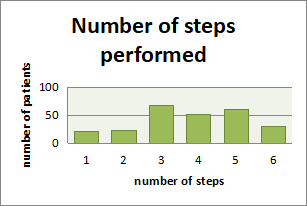
Incorrect inhaler technique (≤5 steps) was adopted by 220 patients (88%) and correct technique (6 steps) was adopted by only 30 patients (12%).Mean no of steps performed was 3.8±1.4 as shown in figure 1.
|
TABLE .2: STRATIFICATION FOR STUDY VARIABLES |
||||
|
Variables |
Number of steps performed. |
Total |
Total P value |
|
|
≤5 steps |
6 steps |
|||
|
Distribution of patients |
220 |
30 |
250 |
|
|
Age <40 40-70 |
93 127 |
7 23 |
100 150 |
P=0.047 |
|
Gender Male Female |
114 106 |
28 2 |
142 108 |
P<0.001 |
|
Occupation Employed Unemployed |
89 21 |
21 9 |
110 140 |
P=0.002 |
|
Education Literate Illiterate |
103 117 |
19 11 |
122 128 |
P=0.090 |
|
Marital status Married Unmarried |
177 43 |
24 6 |
201 49 |
P=0.953 |
|
BMI (kg/m2) ≤ 30 > 30 |
207 13 |
30 - |
237 13 |
P=0.171 |
|
Duration COLD ≤ 10 Years >10 Years |
132 88 |
23 7 |
155 95 |
P=0.078 |
Since the main stay of treatment in COPD or asthma is inhalers, there has been wide search over these devices which have led to production of wide variety of inhalation devices15. There is no doubt about it that these wide advances in production of devices has been of great use to patients but at the same time it has created lot of confusion about their use among patients as well as clinicians 16. As a matter of fact, learning the use of these devices is a quite complicated procedure with many steps involved. Even if only one of these steps is missing, it may lead to overall poor delivery of the drug to lungs with a resultant poor outcome othe f disease. It is now being recognized that this poor inhalation techputsue put a lot of economic burden on health care owing to poor control of disease, as a result of which there are increased hospital visits and increased health care cost.17It has been a worry some fact that even in one of three most developed nations like UK, Sweden and Spain the poor knowledge about inhalation technique has led to a huge increase in cost in 2015 of about 750 million pounds.18It has compounded the entire situation. At one side the number of patients with obstructive lung diseases is constantly rising, while on other hand a lot of cost being involved and increased economic burden is creating a wide gap in management of this disease. This makes it even more imperative to learn the inhalation technique correctly19.It has been reported in a recent study that this poor inhalation technique is being consistently overlooked over past many decades.20
Moreover, the data has also shown the fact that though inhalers being prescribed are accurate and choice of selection is good, but this poor technique has led to poor control of both asthma and COPD18, 21.
It has been observed in our clinical settings as well from multiple previous clinical trials that inhalation techniques need to be taught on repeated basis. We need to check it on repeated OPD visits, reason being failure to comprehend, failure to follow as well as failure to remember the technique. Therefore, repeated counselling may result in better short term and long-term outcome with fewer OPD visits, better performance at work and better sleep with overall increase in quality of life21.In current study, 88% patients used incorrect inhaler technique (≤ 5 steps). Our findings are comparable with the study of Lavorini.7
Another study which has been reported recently has also shown that 86.8% of patients with asthma or COPD had poor inhalation technique when they were using their metered dose inhalers.22A local study done also showed that inhaler technique steps are not followed by the patients.23As a matter of fact the need of this inhalation technique cannot be overemphasized. Poor technique has poor delivery of medicine to the lungs.24
This poor delivery of drug ultimately leads to poor disease control, increased burden on health care resource and last but not the least increased mortality.17, 22, 25
Through several studies done previously as well as through detailed literature review, we have learned that several authors have agreed to this reservation of not following the standardized inhalation techniques. Therefore, we cannot make a standard outcome that whether all physicians are following the same standardized check list or not and whether their selected technique or steps are conclusive enough to produce better result or otherwise. This can give us a model for further studies in this context wherein we can make a comparison among few or multiple selected techniques and compare the results to conclude if one technique produces better outcomes as compared to other. This may help us in forming a better and standardized technique to be followed by all pulmonologist, physicians, or paediatricians.
Our major reservation is that we could manage only one counselling session with each patient and we could not ensure compliance with inhalation technique through further sessions. It has been there due to our time constraints, increased outpatient workload as well as failure of follow up of same patient with same physician owing to their personal as well as social preferences.
Finally, through this study we have learned that this is mandatory:
To educate physicians regarding proper inhalation technique
To pass on this knowledge to patients
To follow a standardized model of inhalation technique
To continue this on repeated basis to ensure better understanding and better compliance.
We infer from our study that patients often fall a victim to poor inhalation technique putting a responsibility on clinicians to make sure that the inhalar device is used precisely and having proper follow up sessions. Moreover, detailed analysis of the steps that are required for appropriate functioning of the device prove beneficial for the individual patients. It is further suggested that future studies done in this respect may have a detailed look into the fact that why these steps are being missed and which steps are missed most frequently.
- Enilari O, Sinha S. The global impact of asthma in adult populations. Annals of global health. 2019;85(1).Adeloye D, Song P, Zhu Y, Campbell H, Sheikh A, Rudan I. Global, regional, and national prevalence of, and risk factors for, chronic obstructive pulmonary disease (COPD) in 2019: a systematic review and modelling analysis. The Lancet Respiratory Medicine. 2022 May 1;10(5):447-58.
- Cataldo D, Hanon S, Peché RV, Schuermans DJ, Degryse JM, De Wulf IA, Elinck K, Leys MH, Rummens PL, Derom E. How to choose the right inhaler using a patient-centric approach? Advances in therapy. 2022 Mar;39(3):1149-63. Lavorini F. Inhaled drug delivery in the hands ofthe patient. J Aerosol Med Pulm Drug Deliv2014; 27:4118
- Petite SE, Hess MW, Wachtel H. The role of the pharmacist in inhaler selection and education in chronic obstructive pulmonary disease. Journal of Pharmacy Technology. 2021 Apr;37(2):95-106.
- Melani AS, Bonavia M, Cilenti V. GruppoEducazionaleAssoci-azioneItalianaPneumologiOspedalieri Inhaler mishandling remains common in real life and is associated with reduced diseasecontrol. Respiratory Med 2011; 105:930–8.
- Price D, Bosnic-Anticevich S, Briggs A, Chrystyn H,Rand C, Scheuch G, et al. Inhaler competence inasthma: common errors, barriers to use and recommended solutions. Respire Med 2013; 107:37–46. Sanchis J, Gich I, and Pedersen S. Systematic review oferrors in inhaler use: has patient technique improved over time? Chest 2016; 150:394–406.
- Braido F, Chrystyn H, Baiardini I. Respiratory Effectiveness Group “Trying, but failing” – the roleof inhaler technique and mode of delivery inrespiratory medication adherence. J Allergy ClinImmunolPract 2016; 4:823–32. Maricoto T, Monteiro L, Gama JMR, Correia-de-Sousa J, Taborda-Barata L. Inhaler techniqueeducation and exacerbation risk in older adultswith asthma or chronic obstructive pulmonarydisease: a meta-analysis. J Am GeriatrSoc 2019; 67:57-66.

An Official Publication of
Islamabad Medical & Dental College
Volume 12 Issue 3
Editorial
Address of Correspondence
Hareema Saeed Khan
Email:
hareemasaeed80@gmail.com
Cite this article.Din SS, Hussain MT, Khan E, Shah M, Sadiq A, Syed A. Comparison of Seroma Formation in Modified Radical Mastectomy: Conventional Scalpel Versus Ligasure™ Technique. J Islamabad Med Dental Coll. 2023; 12(3): 193-198. DOI: https://doi.org/10.35787/jimdc.v12i3.919