Effect of Probiotics on Plasma Glucose Level in Obese Patients on Risk of Gestational Diabetes Mellitus
Naseem Fatima, Saera Afghan, Yasmeen Ara, Majida Zafar, Hadia Hina, Khansa Ahsan
Department of Obstetrics and Gynaecology, Pakistan Institute of Medical Sciences, Islamabad
Objective: A range of physiologic, metabolic, and gut microbial changes occur during pregnancy. Pregnancy is linked to insulin resistance and hyperinsulinemia, which increase the risk of gestational diabetes. Probiotics are being examined extensively for their potential benefits in the treatment of a variety of disorders. This study was planned as there is no local study connected before on supplementation of probiotics in such cases to find the improvement in glycaemic control level and prevention of gestational diabetes (GDM).
Methodology: This one-year randomised control trial was conducted at PIMS Islamabad, department of Obstetrics and Gynaecology. After receiving informed permission, 126 patients were enrolled in the trial. In group A, patients were given standard diet plan along with probiotic sachet daily from 20 weeks of pregnancy till 26 weeks. In group B, patients were given standard diet plan along with routine vitamins daily for same period. Patients were followed-up in OPD up to 26 to 28 weeks and OGTT was done then GDM was labelled if OGTT deranged.
Results: At 28th week in probiotic group the mean fasting blood glucose was 78.84±18.42 mg/dl and in control group it was 81.25±22.49 mg/dl (p-value=0.515). At 28th week in probiotic group the GDM was noted in 12(19%) and in control group it was in 22(34.9%) patients (p-value=0.045).
Conclusion: From this study, we may conclude that there is effective role of probiotic supplementation on prevention of GDM among high-risk obese pregnant.
Keywords: Obese Pregnant Females, Probiotic Supplementation, Gestational Diabetes Mellitus
A range of physiologic, metabolic, and gut microbial changes occur during pregnancy.1 During pregnancy, the composition and structure of the gut microbiota changes dramatically, and these changes persist from the first to the third trimester. During pregnancy, the impact of gut microbiota is similar to that of metabolic syndrome.1 An imbalance in gut flora during pregnancy mimics metabolic dysfunction, with increased inflammation, increased energy content, and impaired insulin sensitivity.2 The dysbiosis of the gut microbiota in obese pregnant women can contribute to metabolic abnormalities including GDM.3 GDM is defined as any degree of glucose intolerance that begins or is recognized during pregnancy, assuming that overt diabetes is not present early in pregnancy.4 The harmful effects of GDM on mother and baby are well documented, emphasizing the significance of early detection and treatment of elevated glycemic levels during pregnancy.5-6 The recommendations for GDM screening are currently being applied insufficiently, particularly for early detection in high-risk women.4,6 The World Health Organization and the International Association of Diabetes and Pregnancy Study Groups advocate a standardised one-step method for GDM screening using the 75 g oral glucose tolerance test. 4
Probiotics are being examined extensively for their potential benefits in the treatment of a variety of disorders.7 Furthermore, probiotics that modify the bacterial flora in the gut may aid in the development of disorders such as asthma and diabetes in newborns.8 Probiotics' effectiveness in reducing gestational hyperglycemia is only partially shown.9
In a few studies, it was found that taking probiotic supplements for 6 weeks improved glycemic control in patients with GDM.10 GDM was diagnosed in 13.2 percent of cases with probiotics and 34.2% of cases with placebo in one study. The distinction was statistically significant (p0.05). 11
In another study, the frequency of GDM was 12.3% with placebo and 18.4% with probiotics, with the difference being trivial (P = 0.10). Probiotic-treated women had a higher mean fasting glucose level (79.3 mg/dL) than placebo-treated women (77.5 mg/dL) (P = 0.049).12 This study assessed probiotic effect on plasma glucose in obesity on risk of GDM.
This one-year randomized control trial was conducted at the Department of Obstetrics and Gynaecology, Pakistan Institute of Medical Sciences, Islamabad. After receiving informed permission and demographic information, 126 patients were enrolled in the trial. In group A, patients were given standard diet plan along with probiotic sachet daily from 20 weeks of pregnancy till 26 weeks. In group B, patients were given standard diet plan along with routine vitamins daily from 20 weeks of pregnancy till 26 weeks. Then patients were followed-up in OPD up to 26 to 28 weeks and OGTT was done then GDM was labelled if OGTT deranged.
In this study total 126 females were participated. The mean age of the females was 28.29±4.13 years with minimum and maximum ages of 21 & 38 years respectively. The mean gestational age on LMP of the females was 17.40±1.13 weeks with minimum and maximum gestational age was 16 & 19 weeks respectively and the mean BMI of the females was 33.03±3.15 kg/m2 with minimum and maximum BMI of 30 & 44.80 kg/m2 respectively. The mean fasting blood glucose level of the females was 82.68±5.45 mg/dl, at 24th week the mean fasting blood glucose of the females was 79.50±9.50 mg/dl and at 28th week the mean fasting blood glucose of the females was 80.05±20.67 mg/dl.
Table I: Comparison of age (years), gestational age on LMP, BMI (kg/m2) & fasting blood glucose between study groups |
|||
Parameters |
Study Groups (Mean±SD) |
p-Value |
|
Probiotic Group (n=63) |
Control Group (n=63) |
||
Age (Years) |
28.82±3.69 |
27.74±4.5 |
0.144 |
Gestational age on LMP |
17.28±1.02 |
17.52±1.23 |
0.240 |
BMI (Kg/m2) |
33.17±3.06 |
32.89±3.26 |
0.623 |
Fasting Blood Glucose |
|||
Baseline |
83.47±4.92 |
81.89±5.87 |
0.103 |
24th Weeks |
79.38 ±6.76 |
79.62±11.67 |
0.889 |
28th Weeks |
78.84±18.24 |
81.25±22.94 |
0.515 |
In probiotic group 25 (39.7%) females had parity 1 and in control group 31 (49.2%) females had parity 1. This difference between parity and study groups was statistically insignificant. i.e. p-value=0.82. The study results showed that deranged OGTT was observed in 34 (26.98%) females.
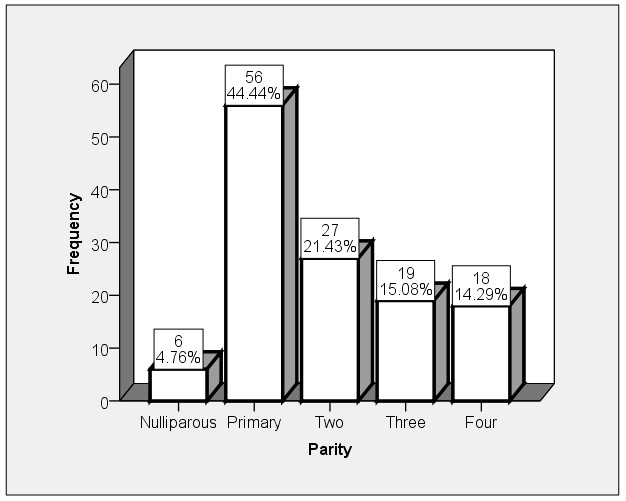
Figure 1: Distribution of parity
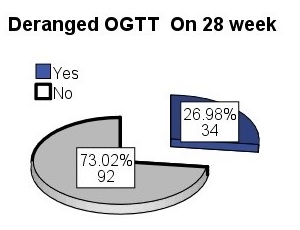
Figure 2: Distribution of deranged OGTT at 28th week
The study results showed that the GDM was observed in 34 (26.98%) females.
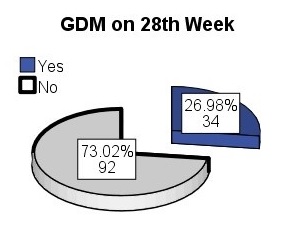
Figure 3: GDM on 28th week
Table II: Comparison of OGTT on 28th week study groups |
|||||
28th week |
Study Groups |
Total |
p-value |
||
Probiotic |
Control |
||||
Deranged OGTT |
Yes |
12 |
22 |
34 |
0.045 |
19.0% |
34.9% |
27.0% |
|||
No |
51 |
41 |
92 |
||
81.0% |
65.1% |
73.0% |
|||
GDM |
Yes |
12 |
22 |
34 |
0.045 |
19.0% |
34.9% |
27.0% |
|||
No |
51 |
41 |
92 |
||
81.0% |
65.1% |
73.0% |
|||
In females having age ≤30 years: in probiotic group the deranged OGTT was noted in 8 (18.2%) females and in control group the deranged OGTT was noted in 12 (26.1%) females (p-value=0.367). In primary parity females: in probiotic group the deranged OGTT was noted in 6 (21.4%) females and in control group the deranged OGTT was noted in 11 (32.4%) females (p-value=0.337). In multi-parity females: in probiotic group the deranged OGTT was noted in 6 (17.1%) females and in control group the deranged OGTT was noted in 11 (37.9%) females (p-value=0.061).
In females having age ≤30 years: in probiotic group the GDM was noted in 8 (18.2%) females and in control group the GDM was noted in 12 (26.1%) females (p-value=0.367). In females having age >30 years: in probiotic group the GDM was noted in 4 (21.1%) females and in control group the GDM was noted in 7 (41.2%) females (p-value=0.020). In females having gestational age on LMP 16-17 weeks: in probiotic group the GDM was noted in 7 (18.9%) females and in control group the GDM was noted in 10 (32.3%) females (p-value=0.206). In females having gestational age 18-19 weeks on LMP: in probiotic group the GDM was noted in 5 (19.2%) females and in control group the GDM was noted in 12 (37.5%) females (p-value=0.206).
In females having BMI ≤25 kg/m2: in probiotic group the GDM was noted in 9 (18.4%) females and in control group the GDM was noted in 15 (30.0%) females (p-value=0.177). In females having BMI>25 kg/m2: in probiotic group the GDM was noted in 4 (21.1%) females and in control group the GDM was noted in 3 (21.4%) females (p-value=0.081).
In primary parity females: in probiotic group the GDM was noted in 6 (21.4%) females and in control group the GDM was noted in 11 (32.4%) females (p-value=0.337). In multi-parity females: in probiotic group the GDM was noted in 6 (17.1%) females and in control group the GDM was noted in 11 (37.9%) females (p-value=0.061).
GDM is linked to a number of short- and long-term negative health consequences in both the mother and the baby, including preeclampsia, instrumental delivery, macrosomia, type 2 diabetes, and cardiovascular disease. GDM is more common in women who are overweight or obese before becoming pregnant.
Until date, GDM prevention strategies have been limited to diet and exercise treatments, which have yielded mixed outcomes.13-15 For a long time, it was assumed that taking probiotic supplements could be a simple and elegant way to avoid GDM.13,14 This insulin is intermediate acting and can be administered twice a day. Because of the substantial peak effect and unpredictable absorption, there is always a considerable danger of hypoglycemia.
The safety profile of new insulin analogues allows us to use them throughout pregnancy with adequate glycemic control and no major risk of hypoglycemia.15,16 In this study in probiotic group the mean age of the females was 28.82±3.69 years and in control group the mean age of the females was 27.74±4.50 years. In probiotic group the mean BMI of the females was 33.17±3.06 kg/m2 and in control group the mean BMI of the females was 32.89±3.26 kg/m2.
A study by Callaway et al.,40 showed in their study that the mean age of the probiotic group patients was 31.3±4.7 years and in control group it was 31.7±4.8 years. In probiotic group the mean BMI of the patients was 31.9±7.5 kg/m2 and in control group it was 31.6±7.2 kg/m2.17 Luoto et al. reported 64% relative reduction in GDM frequency (13% in diet and probiotics, 36% in diet and placebo, and 34% in control groups) in a cohort of 256 pregnant women with a mean BMI of 23.6 kg/m2.18 Given the higher risk of GDM in overweight and obese women and the effectiveness of probiotics in normal-weight women.19
In our study foetal outcome in most of neonates was good, they had birth weight of normal range with good APGAR score. The skin tone noted was also good. In this study 28th week in probiotic group the GDM was noted in 12 (19%) patients and in control group the GDM was noted in 22 (34.9%) patients (p-value=0.045). However, in terms of fasting blood glucose level we found insignificant mean comparison at different intervals. According to this study probiotic showed significant effect in reduction of gestational diabetes mellitus as compared to control group. Probiotics do not appear to pose any safety concerns for pregnant and lactating women. Systemic absorption is rare when probiotics are used by healthy individuals, and the current literature does not indicate an increase in adverse pregnancy outcomes. We can say that in patients with high-risk pregnancy of gestational diabetes mellitus we should use probiotic to overcome this problem and can get maximum benefit from it.
Karamali et al.,20 and Badehnoosh et al.,21 prescribed probiotics for six weeks had a positive effect on birth weight in pregnant females having. With a combination dietary/probiotic supplementation approach, a trial of probiotics in normal weight pregnant females found a reduction in the occurrence of GDM from 34% to 13%.18 In Finland, one study looked at the effect of probiotics on the occurrence of GDM in a high-risk cohort of overweight and obese women. The findings revealed that there was no benefit in lowering the risk of GDM or improving glucose metabolism.22
Another trial found that the frequency of GDM was 12.3% with placebo while 18.4% with probiotics and difference was insignificant (P = 0.10). Mean fasting glucose was higher in women randomized to probiotics (79.3 mg/dL) compared with placebo (77.5 mg/dL) (P = 0.049). 12 Lindsay KL et al found that in pregnant women with obesity, a long treatment duration may be required to see any probiotic effects.23 The avoidance of GDM may minimise the likelihood of macrosomia. A research on dietary treatments, lifestyle modifications, and probiotics supplementation to avoid development of GDM found that consumption or activity alone may not be effective, but the combination of food and lifestyle modifications may be more effective in lowering the rate of GDM.20 Many research has demonstrated the potential involvement of probiotics in improving glycemic control, insulin metabolism, lipid profile, and inflammation in type 2 diabetes mellitus and GDM, according to this theory.20,21 Daily usage of probiotics with 2 major strains of bacteria (L. rhamnosus and B. animalis subspecies lactis) in pregnancy in females having BMI > 25 kg/m2 after 20 weeks of gestation until delivery has been shown to have no good outcomes, or with one strain of bacteria (L. salivarius) by pregnant women with BMI > 30 kg/m2 for 4 weeks from <20 weeks’ gestation to give birth.18,23”
Because our study findings and a little amount of previously published literature are controversial, it is proposed that in the future, bigger sample sizes be used in future investigations, and data should be collected in a multicentre setting to avoid bias.
We may conclude from the outcomes of this study that probiotic supplementation has a beneficial function in the prevention of GDM in high-risk obese pregnant women.
- Zakaria ZZ, Al-Rumaihi S, Al-Absi RS, Farah H, Elamin M, Nader R, Bouabidi S, Suleiman SE, Nasr S, Al-Asmakh M. Physiological Changes and Interactions Between Microbiome and the Host During Pregnancy. Front Cell Infect Microbiol. 2022; 12:824925. https://doi.org/10.3389/fcimb.2022.824925.
- DiGiulio DB, Callahan BJ, McMurdie PJ, Costello EK, Lyell DJ, Robaczewska A, et al. Temporal and spatial variation of the human microbiota during pregnancy. Proc Natl Acad Sci USA. 2015;112(35):11060-5. https://doi.org/10.1073/pnas.
- Adam S, McIntyre HD, Tsoi KY, Kapur A, Ma RC, Dias S, Okong P, Hod M, Poon LC, Smith GN, Bergman L. Pregnancy as an opportunity to prevent type 2 diabetes mellitus: FIGO Best Practice Advice. International Journal of Gynecology & Obstetrics. 2023;160:56-67. https://doi.org/10.1002/ijgo.14537
- Sweeting A, Wong J, Murphy HR, Ross GP. A clinical update on gestational diabetes mellitus. Endocrine reviews. 2022;43(5):763-93. https://doi.org/10.1210/endrev/bnac003.
- Shah B, Sharifi F. Perinatal outcomes for untreated women with gestational diabetes by IADPSG criteria: a population-based study. BJOG. 2020;127(1):116-22. https://doi.org/ 10.1111/1471-0528.15964.
- Rani PR, Begum J. Screening and diagnosis of gestational diabetes mellitus, where do we stand. J Clin Diag Res. 2016;10(4):QE01. https://doi.org/ 10.7860/JCDR/2016
- TK Das, S Pradhan, S Chakrabarti, KC Mondal, K Ghosh. Current status of probiotic and related health benefits. Applied Food Research 2022; 2 (2); 100185. https://doi.org/10.1016/j.afres.2022.100185.
- DeWeerdt S. How baby's first microbes could be crucial to future health. Nature. 2018;555(7695):S18-s9. doi: 10.1038/d41586-018-02480-6
- Asgharian H, Homayouni A, Mirghafourvand M, Mohammad-Alizadeh S. Effect of probiotic yoghurt on plasma glucose in overweight and obese pregnant women: a randomized controlled clinical trial. Eur J Nutr. 2020;59(1):205-15. https://doi.org/ 10.1007/s00394-019-01900-1.
- Karamali M, Dadkhah F, Sadrkhanlou M, Jamilian M, Ahmadi S, Tajabadi-Ebrahimi M, et al. Effects of probiotic supplementation on glycaemic control and lipid profiles in gestational diabetes: a randomized, double-blind, placebo-controlled trial. Diabetes & metabolism. 2016;42(4):234-41. https://doi.org/10.1016/j.diabet.2016.04.009
- Pakmehr A, Ejtahed HS, Shirzad N, Hemmatabadi M, Farhat S, Larijani B. Preventive effect of probiotics supplementation on occurrence of gestational diabetes mellitus: A systematic review and meta-analysis of randomized controlled trials. Frontiers in Medicine. 2022;9:1031915. https://doi.org/10.3389/fmed.2022.1031915
- Callaway LK, McIntyre HD, Barrett HL, Foxcroft K, Tremellen A, Lingwood BE, et al. Probiotics for the prevention of gestational diabetes mellitus in overweight and obese women: findings from the SPRING double-blind randomized controlled trial. Diab Care. 2019;42(3):364-71. https://doi.org/ 10.2337/dc18-2248.
- Han M-M, Sun J-F, Su X-H, Peng Y-F, Goyal H, Wu C-H, et al. Probiotics improve glucose and lipid metabolism in pregnant women: a meta-analysis. Ann Translat Med. 2019;7(5):21. https://doi.org/ 10.21037/atm.2019.01.61
- Alfadhli EM. Gestational diabetes mellitus. Saudi Med J. 2015;36(4):399. https://doi.org/ 10.15537/smj.2015.4.10307
- Jenum AK, Mørkrid K, Sletner L, Vange S, Torper JL, Nakstad B, et al. Impact of ethnicity on gestational diabetes identified with the WHO and the modified International Association of Diabetes and Pregnancy Study Groups criteria: a population-based cohort study. Eur J Endocrinol. 2012;166(2):317-24. https://doi.org/ 10.1530/EJE-11-0866
- Rodriguez Q, Mahdy H. Gestational Diabetes. Treasure Island (FL): StatPearls Publishing; 2022 https://pubmed.ncbi.nlm.nih.gov/31424780
- Davidson SJ, Barrett HL, Price SA, Callaway LK, Nitert MD. Probiotics for preventing gestational diabetes. Cochrane Database Syst Rev. 2021(4):1. https://doi.org/ 10.1002/14651858.CD009951.pub3
- AV Suastika, GR Widiana, NND Fatmawati, K Suastika, IB Paulus, IN Sujaya. The role of probiotics and synbiotics on treatment of gestational diabetes: systematic review and meta-analysis. AJOG Global Reports 2023; 100285. https://doi.org/10.1016/j.xagr.2023.100285.
- C Chatzakis, DG Goulis, E Mareti, M Eleftheriades, A Zavlanos, K Dinas, A Sotiriadis. Prevention of gestational diabetes mellitus in overweight or obese pregnant women: A network meta-analysis. Diabetes Research and Clinical Practice 2019; 158: 107924. https://doi.org/10.1016/j.diabres.2019.107924
- Webber J, Charlton M, Johns N. Diabetes in pregnancy: management of diabetes and its complications from preconception to the postnatal period (NG3). Br J Diab. 2015;15(3):107-11. https://doi.org/10.15277/bjdvd.2015.029
- Rani PR, Begum J. Screening and Diagnosis of Gestational Diabetes Mellitus, Where Do We Stand. J Clin Diagn Res. 2016;10(4):QE01-4. https://doi.org/10.7860/JCDR/2016/17588.7689
- Ardhapurkar SS, SJ Kore, PA Supe. Screening of gestational diabetes mellitus: comparison of glucose challenge test done in non fasting state (DIPSI criteria) and fasting state (WHO criteria): a prospective study. Int J Reprod Contracept, Obstet Gynecol, 2020; 9 (12); 4918 http://www.ijrcog.org/index.php
- Koutnikova H, Genser B, Monteiro-Sepulveda M, Faurie J-M, Rizkalla S, Schrezenmeir J, et al. Impact of bacterial probiotics on obesity, diabetes and non-alcoholic fatty liver disease related variables: a systematic review and meta-analysis of randomised controlled trials. BMJ open. 2019;9(3):e017995 https://doi.org/10.1136/bmjopen-2017-017995.

An Official Publication of
Islamabad Medical & Dental College
Volume 13 Issue 1
Address of Correspondence
Yasmeen Ara
Email:
dryasmeenpims@gmail.com
Authors’ Contribution: 1,2Conception; Literature research; manuscript design and drafting; 2,3 Critical analysis and manuscript review; 5,6 Data analysis; Manuscript Editing.
Cite this article. Fatima N, Afghan S, Ara Y, Zafar M, Hina H, Ahsan K. Effect of Probiotics on Plasma Glucose Level in Obese Patients on Risk of Gestational Diabetes Mellitus. J Islamabad Med Dental Coll. 2024; 13(1): 43-48. DOI: https://doi.org/10.35787/jimdc.v13i1.996